
Tree trimming · Live oak pruning
Live oak pruning in Houston: timing, clearance and canopy care
Live oaks shade many of Houston’s streets, entries and parking lots. Their wide, low limbs and shared roots call for careful timing, light cuts and a plan that looks beyond one tree.
Why live oaks need their own approach
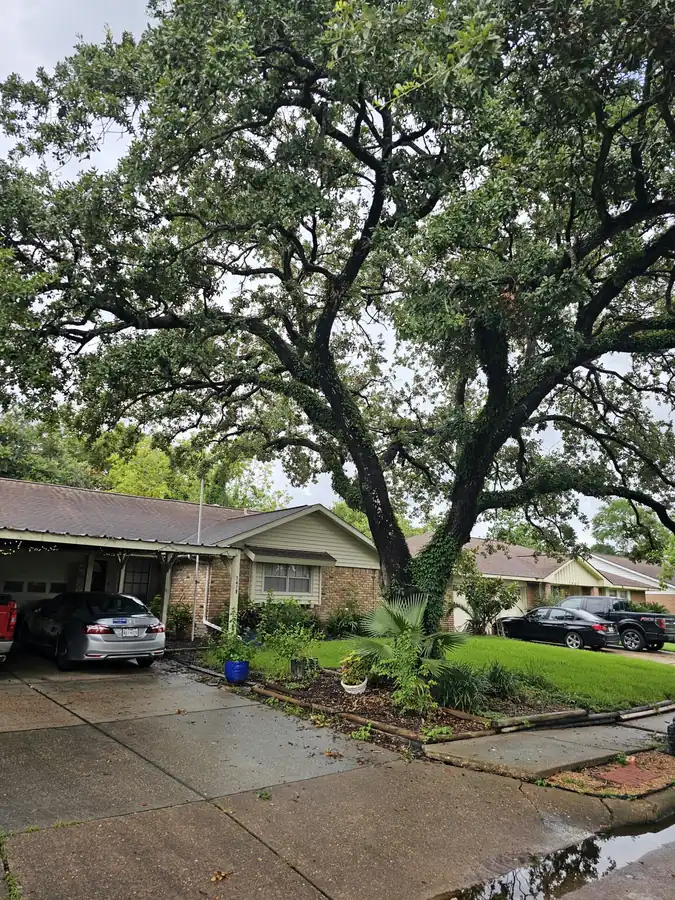
Live oaks grow wide and low, with long horizontal limbs that reach over sidewalks, streets, roofs and parking spaces. That spread is what makes them valuable on HOA common areas and commercial frontage, and it is also what creates most of the pruning requests: low limbs over walks, limbs on roofs, and deadwood over cars.
Live oaks also tend to grow in groups whose roots connect underground. Texas A&M Forest Service calls these groups motts and notes that oak wilt can move through connected roots at an average of about 75 feet per year. A pruning mistake on one live oak can put its neighbors at risk, so live oak work is planned with the whole group in mind.
Timing: the February through June rule
Texas A&M Forest Service describes live oaks as having intermediate susceptibility to oak wilt but being the most affected oaks in Texas, because of their connected roots. Most infected live oaks die over 1 to 6 months after symptoms appear. Routine live oak pruning belongs in midwinter or the long hot stretch of mid to late summer, which Texas A&M Forest Service identifies as the lowest-risk times. Our page on oak pruning and oak wilt season covers the rule in detail.
Common live oak pruning work
Clearance raising
Low limbs over sidewalks and streets are the most frequent request. Clearance rules vary: Sugar Land, for example, requires 8 feet over sidewalks and 12 feet over residential streets. On a live oak, the long lower limbs often carry a large share of the leaves, so raising is done by removing or shortening selected limbs over time rather than stripping the lower crown in one visit.
Cleaning and deadwood
Dead twigs and branches build up inside any large, dense crown. Dead limbs over parking, walks and roofs should come out on a regular cycle. Cleaning removes little live tissue and is the core of most live oak maintenance.
Reduction away from roofs and buildings
Where limbs rest on or grow toward a roof, Texas A&M Forest Service guidance calls for a reduction cut back to a side branch at least one third the diameter of the limb removed. That keeps the limb’s structure and avoids stubs.
Thinning, with restraint
Live oaks are often over-thinned in an effort to “open them up.” Stripping inner branches and leaving foliage only at the ends of limbs is lion’s tailing, which TCIA’s summary of ANSI A300 lists as unacceptable. It puts weight at the limb tips, which is the opposite of what a long horizontal limb needs. Texas A&M Forest Service advises removing no more than 25 percent of the crown at once, and a healthy mature live oak usually needs much less.
Live oaks and drought
Houston’s dry summers stress live oaks, and stressed oaks are more open to problems such as hypoxylon canker. Heavy pruning during or right after drought adds stress. When a property’s live oaks show thin crowns, leaf drop or dieback, a health check comes before a pruning plan. See drought stress and live oak care.

Protecting live oak roots
Most live oak damage on commercial sites starts at ground level: trenching for utilities, added fill, parking on roots and mower strikes on the root flare. The City of Houston’s landscape brochure advises protecting at least 75 percent of a tree’s critical root zone during construction and warns that more than 2 inches of added soil can kill a tree. Our page on construction root protection explains the steps.
What to ask for
- Live oak pruning scheduled outside February through June, with all wounds painted.
- The pruning type for each tree: cleaning, raising, reduction or limited thinning.
- Clearance heights for walks, streets and roofs.
- A stated limit on live tissue removal.
- A note on any oaks in root-connected groups.
How Strong Tree Service scopes live oak work
We walk the property, note each live oak’s clearance issues, deadwood, roof contact and nearby oaks, and write a scope by work zone that lists the trees, the work, access, cleanup, schedule and price. Oak work is scheduled in the lower-risk seasons, and every cut is painted. Safety and training credentials are available on request. Return to tree trimming and pruning for the full service. For a written live oak scope, request a bid.
[1] Source in references below
[2] Source in references below
[3] Source in references below
[4] Source in references below
[5] Source in references below
[6] Source in references below
Frequently asked questions
When is the best time to prune live oaks in Houston?
Midwinter or mid to late summer. Texas A&M Forest Service advises no oak pruning from February through June because of oak wilt, and painting every oak cut in any season.
Should live oaks be thinned to let wind through?
Only lightly, if at all. Removing inner branches and leaving leaves at the limb tips is lion’s tailing, which TCIA lists as unacceptable under ANSI A300. Most mature live oaks need cleaning and targeted reduction more than thinning.
How high should live oak limbs be over the street?
It depends on the city. Sugar Land requires 12 feet over residential streets and 14 feet over nonresidential streets. Houston sets its rules in city code, and we confirm the current requirement for each job.
Why does it matter that live oaks share roots?
Texas A&M Forest Service reports that oak wilt spreads through connected live oak roots at an average of about 75 feet per year. A disease problem in one tree can reach its neighbors, so wound prevention protects the whole group.
References
- Texas A&M Forest Service, Oak wilt disease threatens Texas oaks in spring
- Texas A&M Forest Service, Oak wilt FAQ
- Texas A&M Forest Service, Pruning mature trees
- USDA Forest Service and Texas Forest Service, Identify and Manage Oak Wilt in Texas, SR-1
- City of Houston, Landscape Regulations for Development, 2009
- City of Sugar Land, Tree trimming clearance
Related reading

Request a bid