
Service area · Spring, TX
Tree service in Spring, TX for HOAs, owners and commercial sites
Spring has no city hall and no city tree ordinance. Tall loblolly pines, creek-bottom soils and a patchwork of county, utility district and HOA rules shape every tree job here.
How Spring is governed, and why it matters for tree work
Spring is an unincorporated community. Most of it sits in north Harris County, and the part north of Spring Creek falls in Montgomery County. Spring Creek itself is the county line, so a single drive up Kuykendahl Road or I-45 can cross from one county’s rules into the other’s.
Because there is no incorporated city, three kinds of authority decide what can happen to a tree:
- The county controls public road right-of-way. In Harris County that runs through the Office of the County Engineer and the commissioner precincts. In Montgomery County, start with the precinct office for the road.
- Municipal utility districts (MUDs) provide water, sewer and drainage in most Spring subdivisions, and many own detention ponds, trails or park land with trees on them.
- Homeowners associations enforce deed restrictions. In a deed-restricted subdivision, the HOA’s architectural rules are often the only written tree rule that applies to a private lot.
We found no city or county tree protection ordinance covering private lots in Spring. That does not mean any tree can come down without a second thought. It means the deed restrictions, the HOA’s architectural committee and the owner of the road or easement are the places to check.

Spring’s trees and the problems we see most
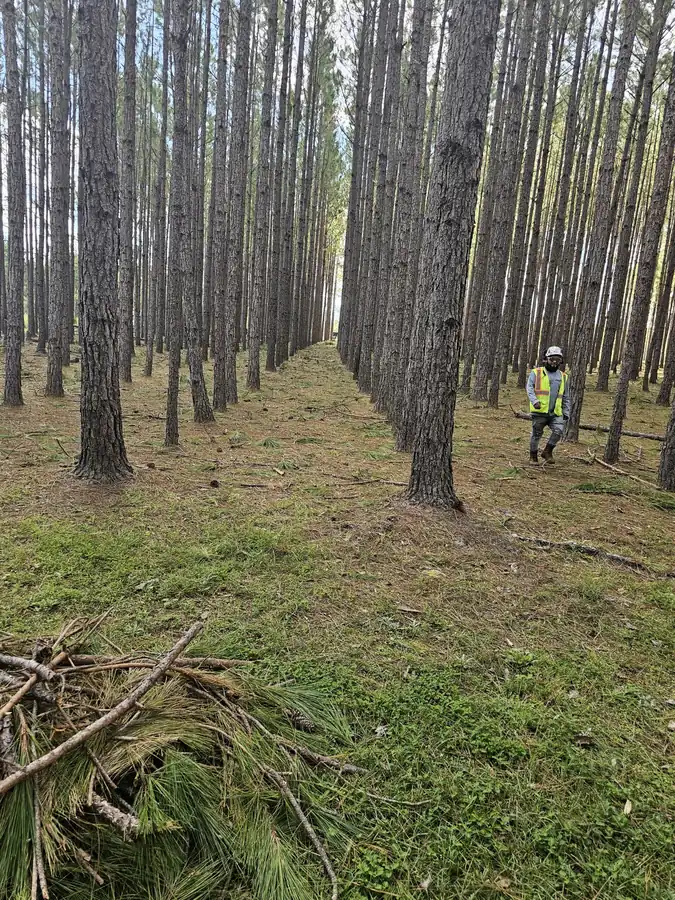
Spring’s canopy is pine-heavy. Loblolly pines tower over most older subdivisions and wooded commercial lots, mixed with water oaks, live oaks, sweetgums, crape myrtles and yaupon. That mix brings a predictable set of problems:
- Pine bark beetles. Southern pine beetle, Ips engraver beetles and black turpentine beetle go after pines that are already stressed. Drought, flooding, storm damage and root cuts from construction are the usual triggers. See plant health care in Spring.
- Drought-killed pines. The 2011 drought hit Harris County’s loblolly pines hardest of any species, according to preliminary Texas Forest Service data reported at the time, and the county set up precinct accounts in 2012 to remove dead and dying trees.
- Creek-bottom flooding. Hurricane Harvey in 2017 pushed Spring Creek out of its banks and set a record on Cypress Creek. Long flooding weakens roots, and trees on saturated soil are more likely to tip in the next wind.
- Wind on tall, narrow pines. A pine that grew up in a stand and was later left alone on a cleared lot has little taper and a small crown to share the load. After Hurricane Beryl in 2024, Texas A&M Forest Service estimated about half of Houston-area urban trees were affected.
[1] Source in references below
[2] Source in references below
[3] Source in references below
Tree services in Spring
Each Spring page below starts with what is different here, then links to the full service page for the method.
| Service | Spring page | Main page |
|---|---|---|
| Pruning and clearance | Tree trimming in Spring | Tree trimming |
| Removal and stumps | Tree removal in Spring | Tree removal |
| Pests, disease and soil | Plant health care in Spring | Plant health care |
| Storm and urgent work | Emergency tree removal in Spring | Emergency tree removal |
| Roads, easements, lines | Right-of-way clearing in Spring | Right-of-way tree clearing |
| Yearly programs | Tree maintenance programs in Spring | Tree maintenance programs |
| Associations | HOA tree service in Spring | HOA tree service |
| Business properties | Commercial tree service in Spring | Commercial tree service |
Property types we work on in Spring
Spring is a suburb of subdivisions, and most of them are deed restricted. Associations around Champion Forest, Gleannloch Farms and the Klein area maintain entrance plantings, greenbelts, pond banks and trails, often next to land owned by a MUD. Old Town Spring has older trees close to historic buildings and tight lots. Commercial work follows the corridors: I-45, FM 2920, Spring Cypress Road, Louetta Road and the Grand Parkway, plus the office campuses of Springwoods Village.
Each property type raises its own first question. For an HOA, it is whether a tree is on common area, on a lot, or on MUD land. For a commercial site, it is whether the trees overhang a county road or a utility easement. For a homeowner, it is what the deed restrictions say.
Power lines in Spring
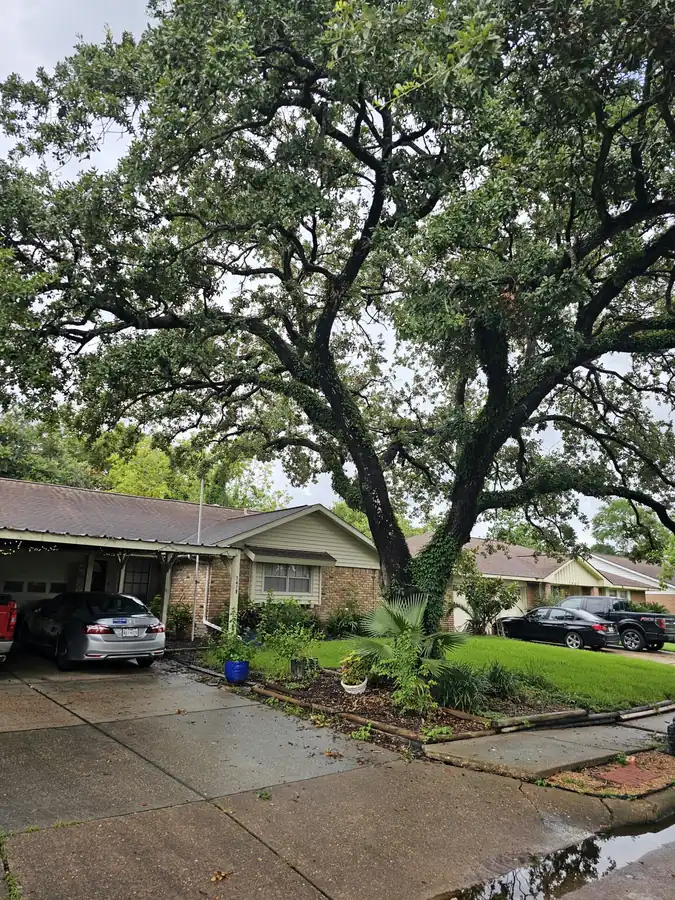
CenterPoint Energy delivers power to most of Spring. Some addresses in southern Montgomery County are served by Entergy Texas, so check the electric bill for the utility name. Branches on or near energized lines are work for the utility or a line-clearance qualified crew. Strong Tree Service coordinates with the utility and works outside the minimum approach distances, and Texas Health and Safety Code Chapter 752 requires 48 hours notice to the utility before work within 6 feet of a high-voltage line. The details are on power line safety and branches touching power lines.
How a Spring job is scoped
Every job starts with a site walk. We look at the trees, the access, who owns the land under each tree, and whether a county road, a MUD tract or a utility line is involved. Then you get a written, itemized scope by work zone that lists the trees, the work on each, access, cleanup, stump depth, schedule and price. On the work day the crew follows that scope, and at the end we clean up and walk the site with you.
Safety and training credentials are available on request, and the crew brings about 15 years in the field. A certificate of insurance and a W-9 are sent on request. To start, request a bid or call (832) 525-1070, the 24/7 emergency tree removal line. Common questions about the company are on the tree service FAQ.
Frequently asked questions
Do I need a permit to remove a tree in Spring, TX?
Spring is unincorporated, so there is no city tree permit, and we found no county tree protection ordinance for private lots. Your deed restrictions or HOA architectural rules may still require approval. If the tree is in a county road right-of-way, contact the county first.
Which county is my Spring address in?
Most of Spring is in Harris County. Addresses north of Spring Creek are in Montgomery County. Your property tax statement or appraisal district record shows the county for certain.
Who handles trees on MUD land in my subdivision?
The MUD that owns the tract is responsible for its trees, often through a contracted operator. Your HOA or the MUD’s board meeting notices can tell you who to contact. Trees on HOA common area belong to the association.
Why are so many pines dying in Spring?
Pines stressed by drought, flooding, storms or root damage attract pine bark beetles, which can kill a tree quickly. A pine with fading needles and pitch tubes on the bark should be looked at soon, because beetles can spread to nearby pines.
Does Strong Tree Service work in both the Harris and Montgomery County parts of Spring?
Yes. We serve Spring on both sides of Spring Creek, along with Houston, Katy, Sugar Land and The Woodlands.
References
Go deeper
Related reading

Request a bid