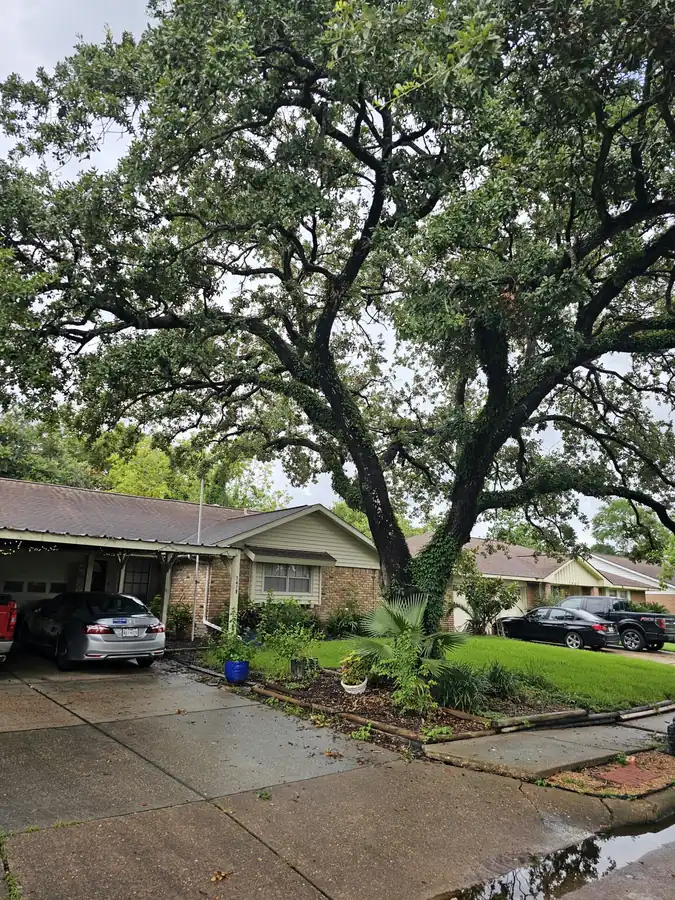
Service · Tree trimming and pruning
Tree trimming and pruning for HOAs and commercial properties in Greater Houston
Good pruning starts with a reason for every cut. We walk the site, write down what each tree needs and why, and prune to the industry standard so canopies stay clear, sound and healthy.
What tree trimming and pruning cover
Trimming and pruning mean removing selected branches from a tree for a stated purpose. On HOA common areas, office parks, retail centers and apartment communities in Houston, Katy, Spring, Sugar Land and The Woodlands, that purpose is usually one of these:
- Clearance over sidewalks, private streets, drive lanes, parking spaces, signs, lights and roofs.
- Risk reduction by removing dead, broken, cracked and weakly attached limbs before they fall.
- Structure in young trees, so they grow one strong trunk and well spaced limbs instead of a weak fork.
- Health by taking out diseased or dying wood and opening a crowded crown.
- Size and shape where a tree has outgrown its space near a building or another tree.
Each kind of cut has a name and a method. Our page on types of pruning explains crown cleaning, thinning, raising, reduction and structural pruning of young trees in plain terms, so a board or manager can read a bid and know what is being bought.
Why the objective comes first
ANSI A300 Part 1 is the U.S. tree care industry’s pruning standard. TCIA, which administers it, summarizes the standard as built around pruning objectives: risk management, plant health, structural development, clearance, size or shape, aesthetics and others. The objective decides which branches come off, how much is removed and which cut is used.
That is why we put the scope in writing before work starts, the way ANSI A300 intends. A line like “trim trees at the entrance” gives no one a way to check the result. A line like “raise the four live oaks along the entry walk for sidewalk clearance and remove dead limbs over 2 inches” does. Our page on pruning to ANSI A300 standards covers the standard in detail, with sample language you can use in a bid request.
Why pruning is a necessity, not a luxury
Trees on commercial and HOA property sit over people, cars and buildings every day. A dead limb over a parking space is a liability the property carries until someone removes it. Low branches over a sidewalk catch pedestrians and block sight lines at drive exits. Limbs rubbing a roof wear shingles and give pests a path to the building.
Young trees are the other reason. A young tree with two competing leaders can be corrected with a few small cuts. Left alone for years, the same tree can split in a storm, and the fix becomes a large reduction or a removal. Early structural pruning is the simplest and smallest pruning a tree will ever need.
How much we remove, and how we cut
Texas A&M Forest Service advises against removing more than 25 percent of a tree’s crown at one time, and mature trees often need less. Over-pruning starves a tree of the leaves that feed it and invites stress problems such as hypoxylon canker and borers, which our plant health care page covers.
Texas A&M Forest Service also describes the cuts we use:
- Cut just outside the branch collar, the swollen ring where a branch joins the trunk. No flush cuts.
- When shortening a limb, cut back to a side branch at least one third the diameter of the limb removed.
- On large limbs, use three cuts: an undercut 12 to 18 inches out from the trunk, a top cut farther out to drop the weight, then the final cut at the collar. This keeps bark from tearing down the trunk.
Oak pruning and oak wilt timing
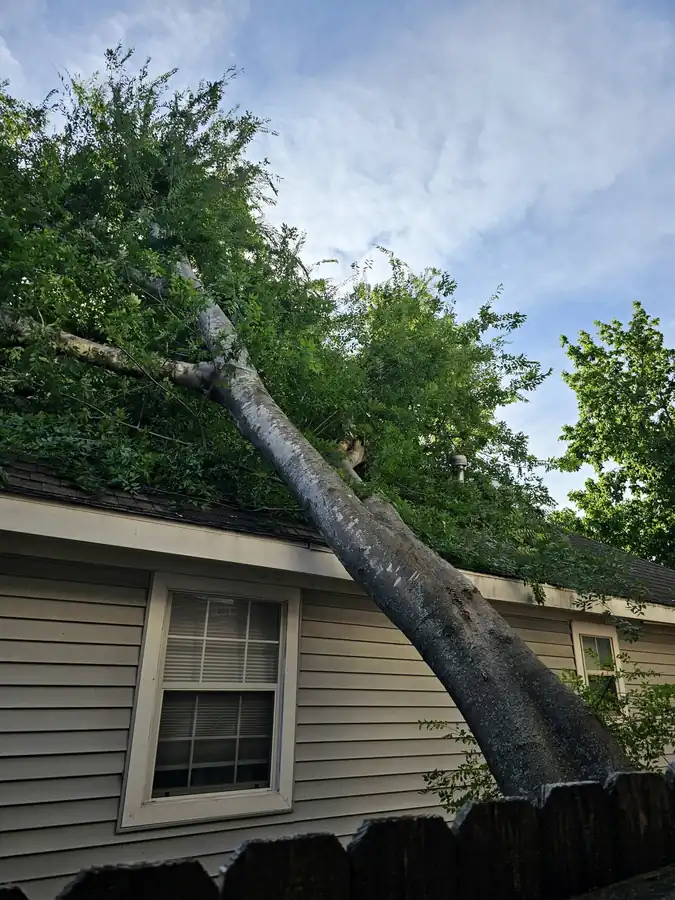
Oaks are the backbone of many Houston landscapes, and they need special timing. Texas A&M Forest Service advises against pruning or wounding oaks from February through June, and says to paint every oak wound in any season. In spring, sap beetles can carry oak wilt spores from infected red oaks to fresh cuts.
We schedule routine oak pruning outside that window and paint oak cuts as we go. If a storm breaks an oak limb during the window, the break is cleaned up and the wound painted right away. Read more on when to prune oaks and the oak wilt season, and on pruning live oaks in Houston, where wide, low canopies and root-connected groves need their own approach. For the disease itself, see our page on oak wilt.
Clearance over sidewalks, streets and signs
Clearance pruning, also called crown raising, removes lower limbs so people and vehicles pass under without contact. Required heights depend on the city.
| Location | Clearance required | Source |
|---|---|---|
| Sugar Land, over sidewalks | 8 feet | City of Sugar Land |
| Sugar Land, over residential streets | 12 feet | City of Sugar Land |
| Sugar Land, over nonresidential streets | 14 feet | City of Sugar Land |
| Houston, sidewalks and streets | Set in city code (Chapter 40); we confirm the current text for each job | City of Houston |
| Katy, Spring, The Woodlands | Check the jurisdiction and the HOA covenants | Varies |
Street trees and trees in rights-of-way bring added rules about who maintains them and when a permit is needed. Our page on right-of-way pruning and maintenance summarizes them and links to our full right-of-way service.
Trees near power lines
Texas Health and Safety Code Chapter 752 bars work that could bring a person, tool or material within 6 feet of a high voltage overhead line unless the line operator has been notified at least 48 hours ahead and a safety arrangement is in place. OSHA keeps workers who are not qualified for electrical work at least 10 feet from lines of 50 kV or less.
When trees on a scope reach toward energized lines, CenterPoint Energy or a line-clearance qualified crew does that part of the work. Strong Tree Service coordinates with them and works outside the minimum approach distances. Details are on our pages about power line safety and branches touching power lines.
Safety on an occupied property
Pruning happens over parking lots, pool decks and walkways that residents and tenants use. OSHA names falls, falling objects and electricity as the main hazards in tree care. On the work day, the crew sets up a marked work zone under the tree, keeps people and cars out of the drop area and stops work in unsafe weather. Our page on pruning safety explains the controls and what we need from the property, such as resident notices and vehicle moves.
What to ask for in a pruning bid
- The objective for each tree or group of trees.
- Which pruning types will be used, and roughly how much will be removed.
- Clearance heights over walks, streets and roofs.
- Oak timing and wound painting.
- How lines near trees will be handled and by whom.
- Cleanup: what is chipped, what is hauled and how the site is left.
- Who leads the work. Safety and training credentials are available on request.
How Strong Tree Service scopes a pruning job
- Site walk. We walk the property with the manager or board contact and look at each tree in the work area.
- Written, itemized scope by work zone. Each zone lists the trees, the work and objective, access, cleanup, schedule and price.
- Work day. The crew sets the work zone, prunes to the scope and chips or hauls the brush.
- Cleanup and final walkthrough. We walk the site with you to confirm each zone matches the scope.
The crew has about 15 years in the field, including work for national tree care firms. A certificate of insurance and a W-9 are sent on request. To get a written scope for your property, request a bid.
Pruning programs for HOAs and portfolios
One-time pruning fixes today’s problems. A program spaces pruning out over years so every tree gets attention on a cycle and the budget is predictable. See tree maintenance programs and pruning cycles and standards, and our pages for HOA tree service and commercial tree service.
[1] Source in references below
[2] Source in references below
[3] Source in references below
[4] Source in references below
[5] Source in references below
[6] Source in references below
[7] Source in references below
Frequently asked questions
Can you prune our live oaks in spring?
Not unless it is an emergency. Texas A&M Forest Service advises against pruning or wounding oaks from February through June because of oak wilt, and says to paint all oak wounds in any season. We schedule routine oak work outside that window.
How much of the tree will you take off?
Texas A&M Forest Service advises removing no more than 25 percent of the crown at one time, and mature trees usually need less. The amount and the reason for it are written into the scope before work starts.
Do you top trees?
No. TCIA’s summary of ANSI A300 Part 1 lists topping as an unacceptable practice. When a tree has outgrown its space, a reduction cut back to a suitable side branch is the standard alternative.
Can you trim the branches near the power line?
Not inside the utility’s clearance zone. Texas law bars work within 6 feet of high voltage lines without an arrangement with the line operator, and OSHA keeps unqualified workers 10 feet away. CenterPoint Energy or a line-clearance qualified crew handles that part, and we work the rest of the tree.
How often should an HOA prune its trees?
There is no single schedule that fits every property. Young trees benefit from structural pruning on shorter cycles, and mature trees can go longer between visits. Our maintenance program pages explain how cycles are set by species, condition and budget.
References
Go deeper
Related reading

Request a bid