
Service area · Sugar Land
Sugar Land tree service built around the city's clearance rules
Sugar Land writes its tree clearance rules into city code and inspects roadway trees on a set schedule. Most of its neighborhoods also answer to an HOA, so good tree work there satisfies both.
Sugar Land at a glance
Sugar Land is an incorporated city in Fort Bend County, southwest of Houston. Much of it was developed as master-planned communities governed by homeowners associations. First Colony, begun in 1977, is a well-known example, and Telfair is a later one. On December 12, 2017, the city annexed Greatwood and New Territory, bringing its population to 117,869 at the time, according to ABC13 and Community Impact. The municipal utility districts that had served those two communities were dissolved, while their levee improvement districts stayed in place.
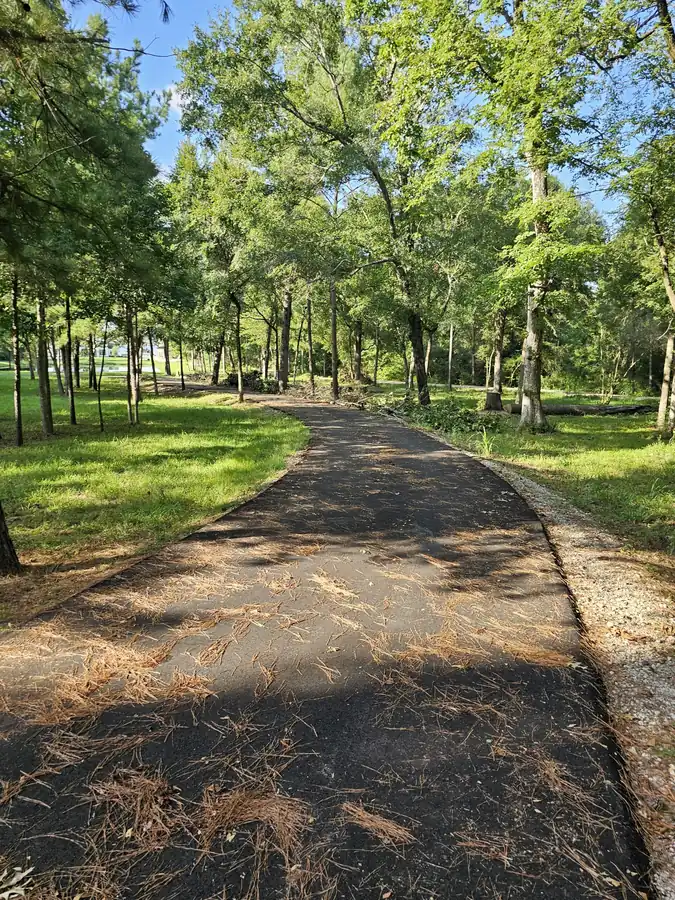
The Brazos River runs along the south side of the city, forming part of New Territory’s southern boundary. Levees, drainage reserves and detention ponds are part of the landscape in many Sugar Land neighborhoods, and so are the trees planted along them.

The city’s tree rules in plain terms
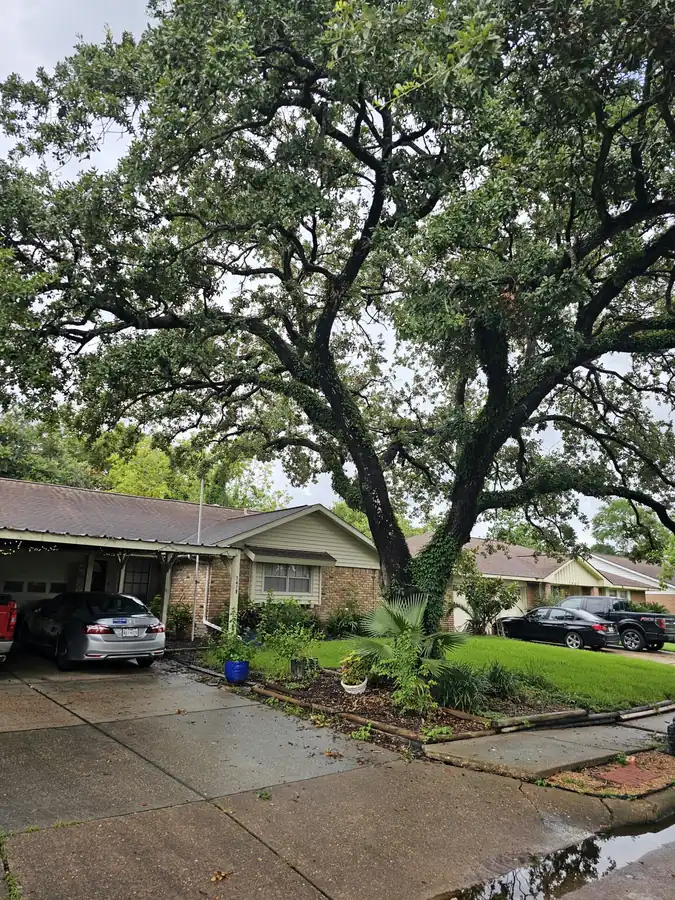
Sugar Land publishes exact clearance heights for private trees that hang over public streets and walks.
| Property type | Over the street | Over the sidewalk |
|---|---|---|
| Residential | 12 feet | 8 feet |
| Nonresidential | 14 feet | 8 feet |
The city says the purpose is to let fire trucks, ambulances and garbage trucks move safely. Residents and business owners must trim their trees when public rights-of-way are affected. The Public Works Department inspects roadway trees every three years and posts inspection schedules for 2026, 2027 and 2028.
Other points from the city’s tree FAQ:
- Ownership. The tree’s owner maintains it. Where an HOA maintains trees in front of homes, the HOA may handle the work, so residents should check first.
- Removal on private property. The city says it has no ordinance for removing trees on private property, but some HOAs have deed restrictions.
- Protected Trees. The Development Code defines a Protected Tree as a hardwood with a caliper of 8 inches or more. Replacement is required for those trees and is decided during the building permit and landscape plan review.
- Right-of-way trees. Adjacent property owners generally own and maintain them and decide whether to replace them.
- City pruning cycle. The city prunes its own trees on a 3 to 5 year rotation and encourages residents to follow a similar schedule.
Trees and conditions in Sugar Land
Live oaks, water oaks, crape myrtles and pines make up much of the planted canopy along Sugar Land streets and reserves. In First Colony, the city notes that trees were planted close together for an immediate look. As they matured, merged canopies shaded out turf, which led to erosion and runoff into storm sewers, and the city removed some roadway trees for that reason. Crowded trees with grafted roots are also more likely to share disease, the city adds.
Storms test this canopy often. After Hurricane Beryl in July 2024, the city began zone-by-zone debris collection on July 12 and finished in about two months, at a cost to the city of $7.6 million, Community Impact reported. Winter Storm Uri in 2021 also produced heavy tree debris.
Sugar Land services
Each Sugar Land page starts from local rules and conditions and links to the full service for the detail:
- Sugar Land tree trimming: meeting the 8, 12 and 14 foot rules without harming the tree.
- Sugar Land tree removal: crowded, dead and storm-damaged trees, plus the Protected Tree rule.
- Sugar Land plant health care: crowded canopies, shade, roots and pests.
- Sugar Land emergency tree removal: what the city clears and what owners must haul.
- Sugar Land right-of-way tree clearing: frontage work timed to the city’s inspection cycle.
- Sugar Land tree maintenance programs: rotations that match the city’s 3 to 5 year approach.
- Sugar Land HOA tree service: boards, deed restrictions and resident questions.
- Sugar Land commercial tree service: 14 foot street clearance for nonresidential sites.
The company-wide service pages are tree trimming, tree removal, plant health care, emergency tree removal, right-of-way tree clearing, tree maintenance programs, HOA tree service and commercial tree service.
Power lines
CenterPoint Energy delivers electricity in Sugar Land. If a limb is on a line or a wire is down, CenterPoint asks people to stay at least 35 feet away, to leave the limb alone and to report it at 713-207-2222. Under Texas Health and Safety Code Chapter 752, unqualified workers stay 6 feet from high-voltage lines, and work closer than that requires 48 hours notice to the utility. CenterPoint or a line-clearance qualified crew handles work inside the minimum approach distances while we coordinate from outside them. Our power line safety page goes further.
How we handle a Sugar Land job
We start by walking the property. Then we write an itemized scope by work zone covering the trees, the work, access, cleanup, stump depth, schedule and price, with the city clearance height written in for every frontage zone. The crew does the work as scoped, cleans up, and we close with a final walkthrough together. Safety and training credentials are available on request, and our crew brings about 15 years of field work. Insurance certificates and W-9 forms go out on request. To start, request a bid.
[1] Source in references below
[2] Source in references below
[3] Source in references below
[4] Source in references below
Frequently asked questions
How high must tree limbs be over streets in Sugar Land?
Residential trees must clear the roadway by 12 feet and nonresidential trees by 14 feet. Both must clear sidewalks by 8 feet. The rule is in Sec. 3-164 of the city code.
Does Sugar Land require a permit to remove a tree on my lot?
The city says it has no ordinance for removing trees on private property. Your HOA’s deed restrictions may still require approval, and Protected Tree replacement can apply during development permits.
How often does Sugar Land inspect trees along streets?
Public Works inspects roadway trees every three years for compliance. The city posts inspection schedules so owners can plan pruning before their area comes up.
Who owns the trees between the sidewalk and the street?
The city says adjacent property owners generally own and maintain right-of-way trees. Where an HOA maintains front-yard trees, it may handle them instead.
Are Greatwood and New Territory part of the city?
Yes. Both were annexed effective December 12, 2017, so city tree rules apply there along with each community’s own HOA rules.
References
Go deeper
Related reading
Request a bid