
Sugar Land · HOA tree service
Sugar Land HOA tree service for boards, managers and residents
In Sugar Land, the city points residents to their HOA before they touch a tree. That makes the association the first stop for tree questions, and its tree vendor part of how the community meets city code.
Where HOAs fit in Sugar Land tree rules
Much of Sugar Land was built as master-planned communities, from First Colony, begun in 1977, to Telfair, and to Greatwood and New Territory, which the city annexed effective December 12, 2017. The city’s tree FAQ refers to HOAs again and again:
- The tree’s owner is responsible for maintenance, but where an HOA maintains the trees in front of homes, it may handle that work. Residents are told to check with their HOA before doing anything.
- The city has no ordinance on removing trees from private property, but it notes that some HOAs have deed restrictions on trees.
- The city asks residents and businesses to keep trees trimmed when they affect public rights-of-way, and that duty falls on the association when it maintains those trees.
So the association often sits between the city’s clearance code and the homeowner. Clear records of which trees the HOA maintains, and which belong to residents, prevent most disputes.
Annexed communities: Greatwood and New Territory
When Greatwood and New Territory joined the city in 2017, the nine MUDs that had served them were dissolved and the city took over their services, while the levee improvement districts stayed. Since then, city tree rules, including the Sec. 3-164 clearances and the three-year roadway inspections, apply in both communities alongside each HOA’s own covenants. Boards in those communities should confirm that their maintenance maps reflect current city responsibilities.
What Sugar Land boards ask us for
- Clearance to city code on entries, medians and street trees the HOA maintains: 12 feet over residential streets and 8 feet over walks.
- Crowded canopy management on older plantings, using thinning and selective removal.
- Lake, levee reserve and trail work, where access is tight and residents walk daily.
- Storm cleanup on common areas.
- Multi-year programs; see Sugar Land tree maintenance programs.
Resident questions and approvals
Many Sugar Land HOA tree questions come from residents: a neighbor’s limb over a fence, a common-area tree shading a yard, or a homeowner who wants to remove a front tree. Our page on common-area versus homeowner trees sorts ownership, resident notices helps boards announce work, and the homeowner approval guide covers architectural review for removals. The statewide guide is our HOA tree service hub.
Budgets and vendor records
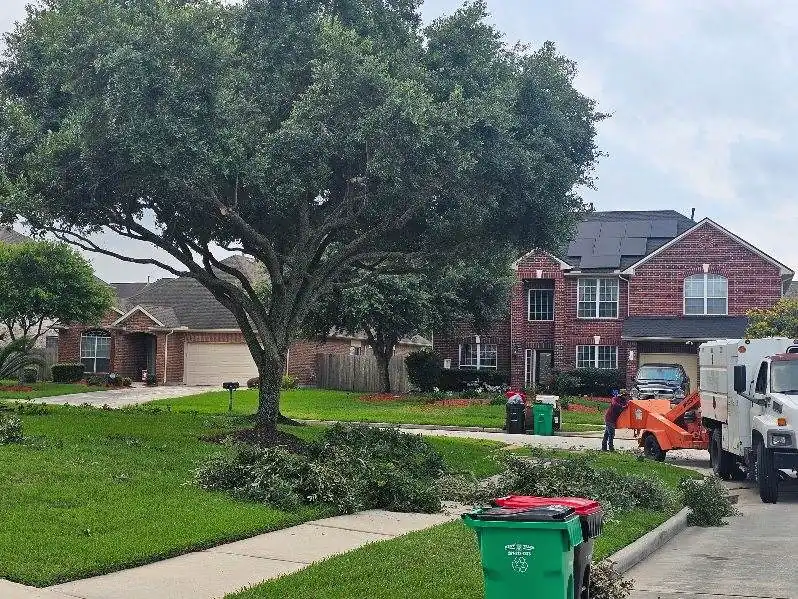
We price by zone so boards can phase work across budget years. Our tree budget and reserves page helps with reserve planning. For vendor files, a certificate of insurance and a W-9 are sent on request, and our page on Texas HOA vendor rules summarizes the state framework.
Local rules
- Clearance: Sec. 3-164, City of Sugar Land Code of Ordinances: 12 feet over residential streets, 14 feet over nonresidential streets, 8 feet over sidewalks.
- Inspection: Public Works checks roadway trees every three years.
- Private lot removal: no city ordinance; HOA deed restrictions govern.
- Protected Trees: replacement for hardwoods of 8 inches caliper or more when removed under a building permit with landscape review.
- Right-of-way trees: generally the adjacent owner’s, unless the HOA maintains them.
What we scope on Sugar Land properties
An HOA scope is written for the board meeting and the site check alike. For each zone, it lists:
- The zone, such as an entry, a frontage segment, a lake edge or a park.
- The trees and the work on each, with the city clearance that applies.
- Ownership flags for any tree that may belong to a resident or another party.
- Access, closures and resident notices.
- Stump depth for any removals.
- Cleanup and hauling.
- Schedule and price per zone.
When the work is finished, we tour each zone with the manager or a board member. The crew is led by our head foreman. For a written HOA scope, request a bid.
[1] Source in references below
[2] Source in references below
Frequently asked questions
Does the HOA or the homeowner trim the tree in front of my Sugar Land house?
The city holds the tree’s owner responsible, but where an HOA maintains front-yard trees, the HOA may handle it. Your covenants and the association’s maintenance records will say.
Can a Sugar Land HOA stop me from removing a tree on my lot?
The city has no private-lot removal ordinance, but some HOAs have deed restrictions on trees. If yours does, follow its approval process first.
Do city clearance rules apply in Greatwood and New Territory?
Yes. Both communities have been part of the city since December 12, 2017, so Sec. 3-164 and the roadway inspections apply there.
How can our board avoid city clearance notices?
Know your sections’ inspection years and schedule clearance pruning ahead of them. A multi-year program makes that routine.
References
Related reading

Request a bid