

HOA · Tree budget and reserves
Budgeting for HOA trees: operating budget, reserves and bids
Trees do not wear out on a schedule the way a roof does, which is why they confuse budgets. Here is how most associations handle tree costs, and how to keep the number steady from year to year.
General information only. This page is not legal or accounting advice. Your reserve study provider, manager and attorney have the final word.
Operating budget or reserve study?
A reserve study plans for the replacement of major components, such as roofs, paving and pool equipment, that wear out over a predictable life. Trees are different. They grow, they need care every year and they fail on no fixed schedule.
In practice, most associations budget routine tree work as an operating expense. Large, planned projects, such as a full replacement of an aging entrance planting, may be discussed with the reserve study provider.
No Texas statute requiring HOA reserve studies was found in our research. Some governing documents require them, so check yours.

Build the operating budget by zone
A single “tree service” line hides what the money buys. Splitting it by zone shows the board where the money goes and makes phasing easy. Typical zones:
| Zone | Common work |
|---|---|
| Entrance and monuments | Cycle pruning, young-tree care, replacements |
| Parks and greenbelts | Risk work, deadwood removal, trail clearance |
| Private streets | Clearance pruning for trucks, buses and sight lines |
| Ponds and drainage | Limb and brush removal near inlets and outfalls |
| Amenity center | Clearance over roofs, decks and parking |
| Perimeter | Pruning off walls and fences, buffer work |
Each zone then gets lines for cycle pruning, risk work, removals, stump grinding, planting and an emergency reserve. The budgeting and board reporting page shows a full layout.
Let the cycle keep the years level
When every tree is pruned in the same year, the budget swings. When zones are spread across a cycle, about the same share of the trees is pruned each year. Many urban forestry programs use about a five-year cycle for mature trees, an industry norm supported by a Milwaukee street tree study in Arboriculture and Urban Forestry and by UMass Extension. With five zones on a five-year cycle, each year carries one zone’s pruning plus risk work across the rest.
Plan an emergency line
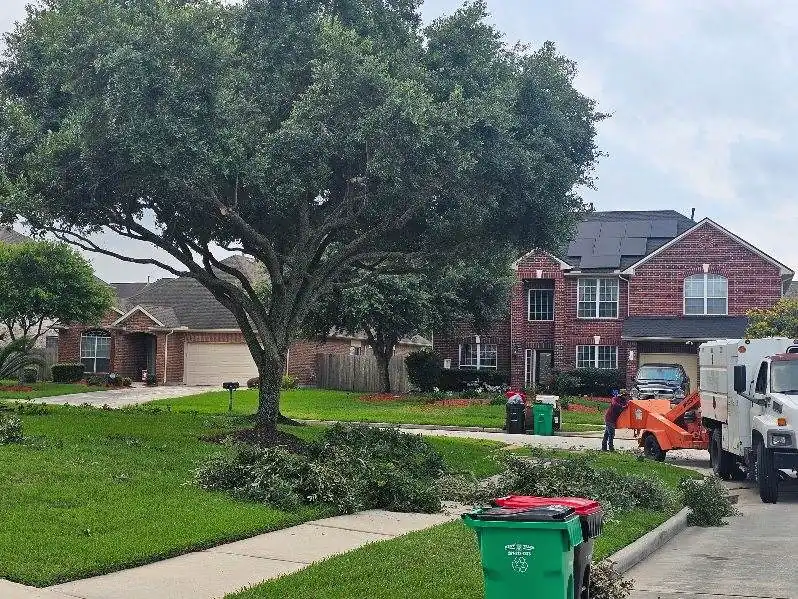
Storms are not optional in Houston. After Hurricane Beryl in 2024, Texas A&M Forest Service estimated that about half of Houston-area urban trees were affected, as reported by Texas A&M AgriLife Today. An emergency line in the operating budget, paired with a pre-signed emergency authorization with a not-to-exceed amount, lets the board respond without scrambling. See the HOA hurricane tree plan.
Note that FEMA generally does not pay for debris on private property, and private road debris in HOA communities is eligible only in some declared disasters, through the local government. Do not budget on the assumption that FEMA will cover a storm.
Bids and the $50,000 rule
A multi-year tree program for a large community can cross that line. Itemized bids by zone let the board compare vendors line by line rather than on one total. The same section adds conditions for contracts with a current board member, a close relative or a company either controls. See Texas HOA vendor rules.
Approving the budget
Under Texas Property Code 209.0051, approving or amending the annual budget cannot be done outside a noticed open meeting. Regular board meetings need notice at least 144 hours ahead, and special meetings at least 72 hours ahead. Associations subject to the Texas Open Meetings Act follow that Act instead. So the tree proposal needs to be ready before the budget meeting, with time to include it in the board packet.
Contracts themselves are not on the list of items that must be decided in a meeting, so a board can often approve a specific tree contract by an out-of-meeting vote if every director can weigh in and vote and the action is recorded at the next meeting. Check your documents with your attorney.
A note for residents
Residents sometimes ask why the tree budget changes, or why a tree near their home was not pruned this year. In a cycle, each zone has its year. The board’s report or the manager can show when your zone is scheduled. Hazards are handled as risk work in any year.
How Strong Tree Service supports the budget
It starts with a site walk. You then get a written, itemized scope by work zone: the trees, the work, access, cleanup, stump depth, the schedule and the price. Because the scope is already split by zone, the treasurer can drop it into a multi-year budget and the board can compare it with other bids line by line. To get a zone scope in time for your budget meeting, request a bid. The full program is on HOA tree maintenance.
[1] Source in references below
[2] Source in references below
[3] Source in references below
[4] Source in references below
[5] Source in references below
Frequently asked questions
Should tree costs go in our reserve study?
Usually not. One reserve study firm says landscaping is generally an operating expense that most providers leave out by default, and CAI’s standards use a three-part test to decide. Ask your reserve study provider.
Is our HOA required to have a reserve study?
No Texas statute requiring HOA reserve studies was found in our research. Some governing documents require one, so check yours.
How do we keep the tree budget steady each year?
Split the property into zones and spread pruning across a cycle, so about the same share of trees is pruned each year. Add a fixed emergency line for storms.
Does our HOA need bids for tree work?
For service contracts over $50,000, Texas Property Code 209.0052 requires a bid process set by the association. Itemized bids by zone make comparison easier.
Can the tree budget be approved by email?
No. Under Texas Property Code 209.0051, approving or amending the annual budget must happen at a noticed open meeting. Some contracts can be approved outside a meeting under the conditions in that section.
References
Related reading
Request a bid