

Houston · Tree maintenance programs
Houston tree maintenance programs built on the city's own calendar
A Houston tree program has to fit two seasons that overlap, oak wilt season in spring and hurricane season from June, plus a 20-day permit posting for any city tree. Here is how that calendar works.
Why Houston properties need a program, not a call list
Most Houston properties manage trees by reaction: a limb falls, a resident complains, a storm hits. After the May 2024 derecho and Hurricane Beryl two months later, many boards and owners found that reaction is expensive. Texas A&M Forest Service estimated that Beryl alone affected about half of Houston-area urban trees, as reported by Texas A&M AgriLife Today, and experts quoted by Houston Landing said the derecho may have weakened trees that then failed in Beryl.
A program changes that. Trees are inventoried, inspected and pruned on a planned cycle, and defects are found before the wind finds them. No program can promise a tree will not fail. It lowers the odds and spreads the cost evenly over years.
The Houston calendar
Three local constraints shape the year inside the City of Houston:
- Oak wilt season, February through June. Texas A&M Forest Service advises against pruning or wounding oaks in that window. Houston’s older streets are lined with live oaks, so oak pruning belongs in winter or midsummer.
- Hurricane season, June 1 through November 30. Deadwood removal, hanger removal and inspection of storm-weakened trees should be done before June.
- City permit lead time. Trimming or removing a tree on city property, including the right-of-way, a median or a setback, needs PRD1001, posted 20 days before work. Program work on city trees is filed well ahead of its window.
| Months | Main Houston program work |
|---|---|
| December to January | Oak structural pruning and clearance, removals, permit filing for spring and summer city tree work |
| February to May | Non-oak pruning, pine and crape myrtle work, pre-storm inspections, deadwood and hanger removal on non-oaks |
| June to August | Midsummer oak pruning, watering checks in dry spells, storm response |
| September to November | Post-storm inspections, inventory updates, budget and plan for the next year |
The detailed calendar is on the Houston seasonal calendar.
Pruning cycles for Houston trees
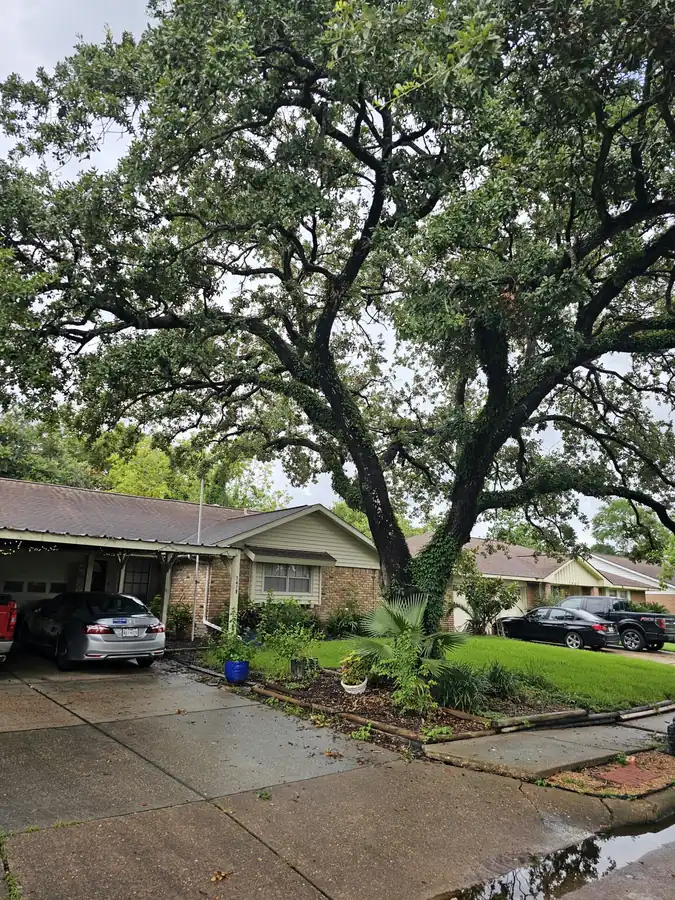
Cycle length depends on species, age and the property’s goals. Young street trees benefit from short cycles of structural pruning so they grow a strong form. Mature live oaks over streets and sidewalks need regular clearance and deadwood work. Pines near buildings need regular inspection, especially after drought. The standards behind cycle length are on pruning cycles and standards.
Inventory and risk
A program starts with an inventory: each tree’s location, species, size, condition and defects, and whether it sits on private land, in a setback or in the city right-of-way. For Houston properties, the inventory also flags trees near CenterPoint lines and trees covered by deed restrictions or HOA rules. Trees with defects get a risk rating and a recommended action. See tree inventory and risk assessment.
Local rules
- City of Houston Chapter 33: trees on city property need PRD1001 for trimming or removal, with 20 days of public posting. Article VI covers trees in the street, and Article V sets replacement requirements for protected trees in development.
- City of Houston Chapter 40: contains the sidewalk clearance rule. Clearance work along sidewalks is part of most Houston programs.
- Urban Forestry: the city trims street trees for height clearance and removes dead or hazardous ones in the right-of-way. A program notes which trees the city is likely to handle and which belong to the property.
- Deed restrictions and HOA rules: check the governing documents for approval, replacement and species requirements.
- CenterPoint lines: trees near lines are flagged, and work inside the minimum approach distance is left for CenterPoint or a line-clearance qualified crew.
Budgeting a Houston program
Boards and owners usually want a predictable number. A multiyear program divides the property into zones and spreads pruning across years, with a separate reserve line for storms and unplanned removals. The approach to budgets and board reporting is on budgeting and board reporting. The full service is on tree maintenance programs.
What we scope on Houston properties
A program scope is a written, itemized plan by work zone, usually covering three to five years:
- Inventory: every tree, with ownership status (private, city right-of-way, setback) and proximity to CenterPoint lines.
- Year-by-year work: pruning type and objective for each zone, removals, and inspections.
- Timing: each task placed in the calendar, with oaks outside February to June and storm prep before June.
- Permits: which city trees need PRD1001 and when to file.
- Access, cleanup and stump depth for each zone.
- Price by year, with a storm reserve line.
- Reporting: a walkthrough after each visit and an updated inventory each year.
Safety and training credentials are available on request. To start a Houston program with an inventory, request a bid.
[1] Source in references below
[2] Source in references below
[3] Source in references below
[4] Source in references below
Frequently asked questions
When should a Houston program schedule live oak pruning?
In winter or midsummer. Texas A&M Forest Service advises against pruning or wounding oaks from February through June because of oak wilt, and every oak wound should be painted.
How does hurricane season change a Houston program?
Deadwood, hangers and storm-weakened trees should be handled before June 1. After each storm season, the program adds an inspection to catch cracked unions and leaning trees.
Does a program include the city trees along our frontage?
It lists them, because they affect the property. Trimming or removing them needs a city permit, and the city’s Urban Forestry group handles routine clearance and hazardous street trees. The program notes which tasks belong to the city and which to the property.
How far ahead should we plan city tree work?
At least a month for planned work. The PRD1001 permit takes about 10 business days to process and must be posted 20 days before work.
References
Related reading
Request a bid