
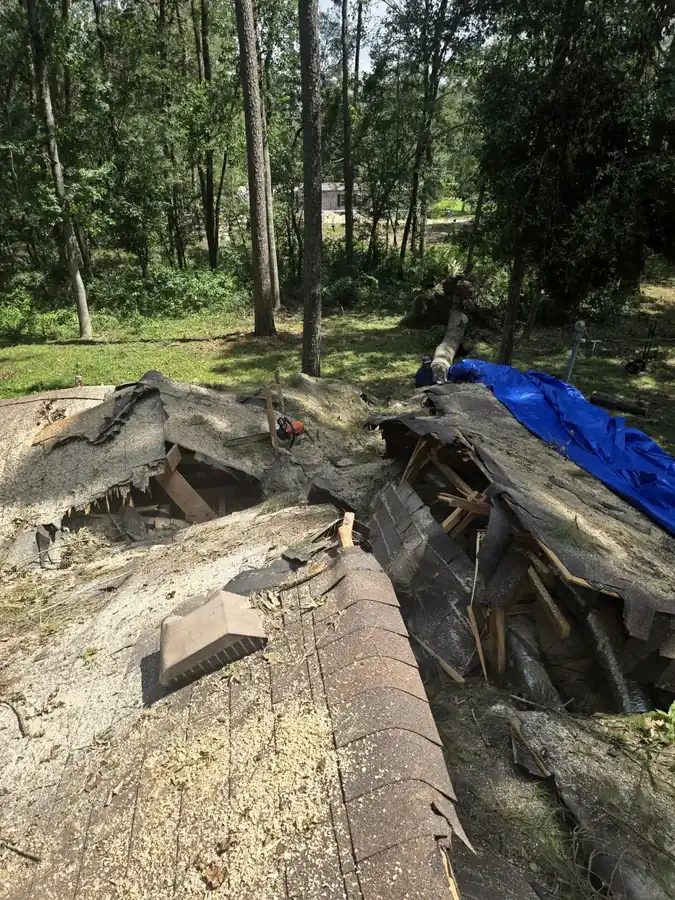
Houston · Emergency tree removal
Houston emergency tree removal, planned around what the last four storms showed
Ike, Harvey, the May 2024 derecho and Beryl each broke Houston trees in a different way. Knowing those patterns, and who handles what inside the city, speeds up a safe response.
Four storms, four kinds of damage
Houston’s recent storm record is a practical guide to what an emergency call will look like.
Hurricane Ike, September 2008. Researchers who had measured 37 Houston urban forest plots in 2001 went back after Ike. They found the storm removed 4.3 percent of the trees measured, with losses on six of the 37 plots (Staudhammer and others, Arboriculture and Urban Forestry, 2011). The losses were concentrated on a minority of plots, which matches what crews see after a hurricane: one block is hit hard while the next is untouched.
Hurricane Harvey, August 2017. Harvey’s lesson was water. Texas A&M Forest Service found trees in Harris County’s Bear Creek Park, under about four feet of water for months, dying back the next summer. On the coast, the agency’s teams saw live oaks damaged in the crown or blown over. Flooded trees can become hazards long after the storm has passed.
The derecho, May 16, 2024. This fast-moving windstorm brought straight-line winds that the National Weather Service survey estimated near 100 mph downtown, as reported by NBC, and nearly 900,000 CenterPoint customers lost power. A CenterPoint official described whole trees being uprooted into lines. Houston Landing reported the city received 10,066 calls to 311 about trees after the storm.
Hurricane Beryl, July 8, 2024. Texas A&M Forest Service estimated that about half of Houston-area urban trees were affected, as reported by Texas A&M AgriLife Today. S&P Global reported that 2.26 million of CenterPoint’s roughly 2.6 million customers were offline as the storm left.
What a Houston emergency usually involves
Inside the City of Houston, storm calls tend to share a few features:
- Trees through lines. Older neighborhoods have overhead distribution lines and service drops running through the canopy. A fallen oak often brings wires down with it.
- Trees across streets. Street trees in planting strips and esplanades fall into the roadway, blocking residents and emergency vehicles.
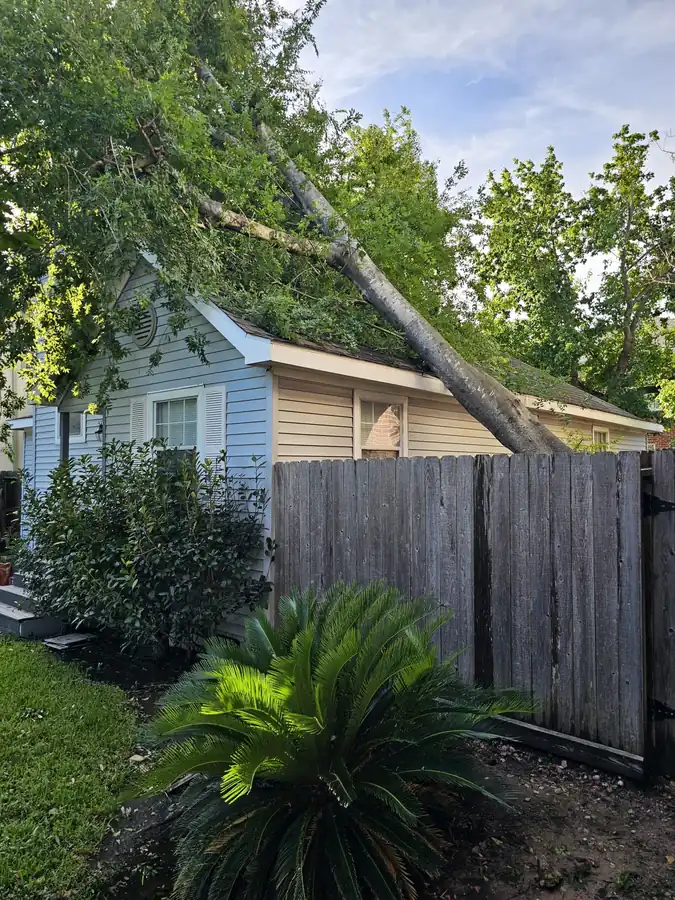
- Trees on roofs and cars on tight inside-the-Loop lots, where there is little room to work.
- Split and leaning trees left standing, which can fail days later.
Who handles what in Houston
| Situation | Who acts first |
|---|---|
| Any tree touching or near a downed or energized line | CenterPoint Energy. Report downed lines at 713-207-2222 and stay away. |
| Tree on private property, on a house, car or fence | The owner, through a tree service |
| Tree from the street right-of-way blocking a city street | The City of Houston. Report it through 311. |
| Tree on a private HOA street or a commercial lot | The HOA or owner, through a tree service |
How emergency removal is done
The emergency order is hazards first, then structures, then access, then cleanup. On a house, that means stabilizing the tree before cutting so it does not shift into the roof, then lowering sections in a controlled way. When the job needs it, we arrange a crane. Details are on emergency tree removal and the storm cleanup process.
For insurance claims, photos before and during work, an itemized invoice and notes on what struck what all help. See insurance documentation.
Local rules
- City trees after a storm: a tree on city property, including the right-of-way, a median or a setback, is still a city tree after it falls or splits. If an owner removes an emergency hazard from city property, check with the city’s Urban Forestry group about documentation afterward.
- Power lines: Texas Health and Safety Code Chapter 752 bars work within 6 feet of high-voltage lines without notice to the operator and safety arrangements.
- Unincorporated Harris County: debris and tree rules along county roads follow county procedures, not the city’s.
- HOAs: check the association’s governing documents and any storm plan for who can authorize emergency work.
Getting ready before June
Storm damage cannot be ruled out, but preparation helps. Before hurricane season, have trees walked for dead wood, hangers, split unions and lifted roots, especially trees that went through the derecho and Beryl. HOAs should keep a signed emergency authorization and current vendor paperwork on file. See hurricane season prep and the HOA hurricane plan.
What we scope on Houston properties
For a storm job, the written, itemized scope by work zone covers:
- Each damaged tree and what it is on or blocking, with photos.
- Whether the tree is private, city right-of-way or near CenterPoint lines, and what is left for the utility.
- The method: stabilizing, rigging and sectional removal, or arranged lifting equipment when the job needs it.
- Access, protection of the structure, and temporary measures such as clearing a drive or a fire lane.
- Cleanup, debris hauling, stump depth, schedule and price, followed by a final walkthrough.
Our 24/7 emergency tree removal line is (832) 525-1070. For planned storm preparation, request a bid.
[1] Source in references below
[2] Source in references below
[3] Source in references below
[4] Source in references below
[5] Source in references below
[6] Source in references below
[7] Source in references below
[8] Source in references below
[9] Source in references below
Frequently asked questions
Who removes a city tree that fell across my Houston street?
A tree from the street right-of-way is a city tree, so report it to the City of Houston through 311. If it is on wires, call CenterPoint at 713-207-2222 first. If the tree landed on your house, you can hire a tree service to remove it from your property.
A tree is lying on a line in my yard. What should I do?
Stay well away, keep others away and call CenterPoint at 713-207-2222. Do not try to move the tree or the wire. Once CenterPoint has made the line safe, a tree service can remove the rest.
Why did so many Houston trees fail in Beryl?
Experts quoted by Houston Landing pointed to several factors working together: drought stress from 2023, damage left by the May 2024 derecho, saturated soil and strong winds. Texas A&M Forest Service estimated about half of Houston-area urban trees were affected.
Can trees damaged in a storm be saved?
Some can, with pruning to remove broken wood. Others have split trunks, torn roots or major unions cracked and should come down. An ISA Certified Arborist can assess each tree, though no one can guarantee how a damaged tree will perform.
Do you answer emergency calls at night in Houston?
Our 24/7 emergency tree removal line is (832) 525-1070. We assess the situation by phone and plan the safest next step.
References
- Staudhammer and others, Rapid Assessment of Change and Hurricane Impacts to Houston’s Urban Forest Structure, Arboriculture and Urban Forestry 37(2), 2011
- Texas A&M Forest Service, Urban Forest Strike Team surveys Houston trees for flooding effects of Hurricane Harvey
- Texas A&M Forest Service, Urban Forest Strike Teams mobilized after Harvey
- NBC DFW, Straight-line winds and tornado in Houston, NWS report
- Houston Landing, Severe storm hits Houston area, nearly 900,000 CenterPoint customers
- Houston Landing, Why did so many trees fall after Hurricane Beryl
- Texas A&M AgriLife Today, Hurricane Beryl slams into Houston area
- S&P Global, Almost 1 million East Texas power customers still in dark since Beryl
- CenterPoint Energy, Downed power lines and safety after a storm
Related reading
Request a bid