
Tree removal · Crane and rigging
Crane-assisted and rigged tree removal in Greater Houston
When a large tree stands over a building, pool or parking deck, it cannot simply be felled. It comes down in pieces, either lowered on ropes or lifted out by crane, and the choice between them is a safety decision.
Rigging and cranes: two ways to take a tree apart
Rigging means cutting a tree into pieces and lowering each piece on ropes through a block or lowering device anchored in the tree. A ground crew controls the rope with friction so the piece comes down slowly and lands in a planned spot. Rigging works in tight spaces and does not need a crane setup area.
Crane-assisted removal means a crane holds each piece before it is cut, then lifts it clear of the building or obstacle and sets it down in an open area. No weight is lowered past the roof, and the tree itself does not have to carry rigging loads.
Many removals near structures can be done with rigging alone. When the job needs it, we arrange a crane and operator.
When rigging is enough
- The tree is sound enough to climb and anchor in.
- Pieces can be lowered into a clear landing area without swinging into the structure.
- Limb and trunk sizes are within what the rigging system and the tree can safely hold.
- There is room for the ground crew to work the lowering rope.
When a crane is the safer choice
- Decay or dead wood. The tree may not be safe to climb or strong enough to hold rigging loads. Texas A&M guidance notes that dead pines become brittle 6 to 10 months after death.
- No landing zone. The tree is surrounded by roof, pool or paving, with nowhere to lower pieces.
- Very large wood. Trunk sections are too heavy to lower on ropes with acceptable control.
- Leaning over a structure. The tree’s weight is already loaded toward the building.
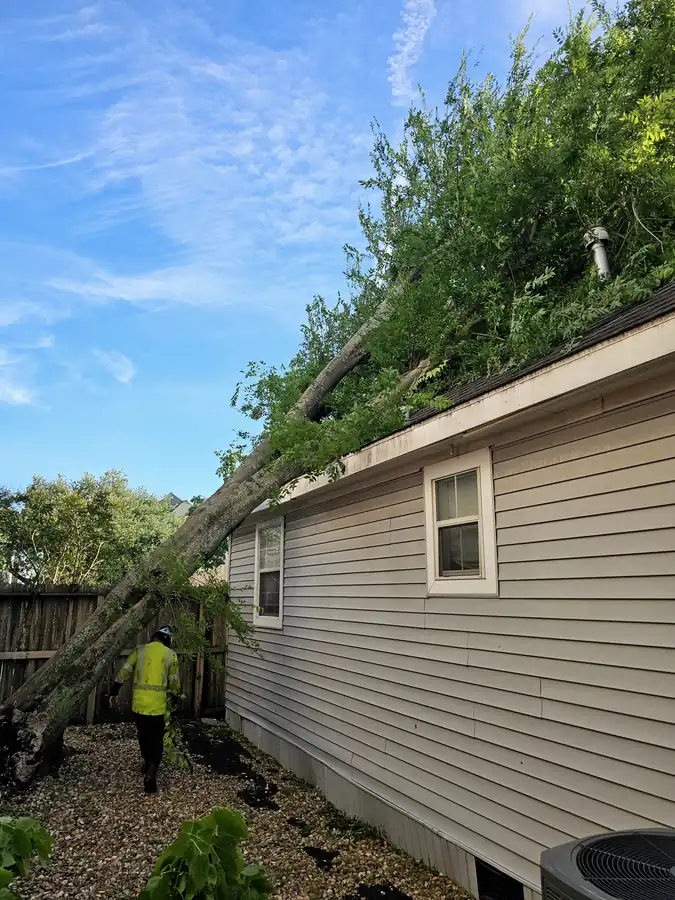
- Storm damage. Split or hung trees can be stabilized by the crane before cuts are made.
Lift planning
A crane removal starts with a plan, not a phone call. The plan covers:
- Crane location. Where the crane sets up, how far it must reach and what it lifts over.
- Piece weights. Each piece is sized so its estimated weight is within the crane’s capacity at that reach.
- Ground conditions. Soft soil, irrigation lines, septic systems, utilities and thin paving all affect where outriggers can go. Outrigger pads or mats spread the load.
- Landing area. Where pieces are set down to be cut up and chipped.
- Overhead lines. Where the boom and load will travel relative to every line on site.
- Communication. A signal person and agreed hand signals or radios between the climber, the operator and the ground crew.
Power lines and cranes
Texas Health and Safety Code Chapter 752 also bars work within 6 feet of lines over 600 volts unless the line operator has been notified at least 48 hours ahead and a safety arrangement is in place. When lines are within reach, CenterPoint Energy or a line-clearance qualified crew handles that part, and Strong Tree Service coordinates and works outside the minimum approach distances. See power line safety.
Which crane rules apply
Tree work is treated as general industry work, so OSHA’s general industry crane rule is the one most often cited for tree removal cranes. Published federal guidance comparing it with the construction crane rule for tree work was not found in our research, so we do not state the question as settled. What a buyer can confirm is simple: who provides the crane, who operates it, and what documentation the operator carries. Ask for that in writing.
Protecting the site
- Mats and plywood over lawns and soft ground where trucks and the crane travel.
- Pads under outriggers to spread the load on paving and turf.
- Roof and gutter protection for rigged pieces near the building.
- Path control for the chip truck and log loading, kept away from foot traffic.
Ruts and compaction also matter for the trees that stay. Heavy equipment over root zones can damage roots, so access routes avoid nearby trees where possible. See construction root protection.
What to ask any contractor
- Will this tree be rigged down or lifted out, and why?
- If a crane is used, who supplies it and who operates it?
- Where will the crane set up, and how will the ground and paving be protected?
- Where are the overhead lines, and how will the boom stay clear?
- What is the plan if wind picks up during the lift?
How Strong Tree Service scopes crane and rigging work
On the site walk, our head foreman checks the tree’s condition, the structures around it, the landing areas and the overhead lines. The written scope lists the trees, the method, access, site protection, cleanup, stump depth, schedule and price. When a crane is needed, the scope says so and names who provides it. The crew has about 15 years in the field. For removals close to buildings without a crane, see limited-access and near-structure removal. For the full service, see tree removal. To have a tight removal planned and priced, request a bid.
[1] Source in references below
[2] Source in references below
[3] Source in references below
[4] Source in references below
Frequently asked questions
Is a crane removal more expensive than rigging?
A crane adds its own cost, but it can shorten the job and lower the risk on large, decayed or hard-to-reach trees. The choice is made on the site walk, and the scope explains why one method was chosen.
Will a crane damage our parking lot or lawn?
Outrigger pads and ground mats spread the load, and access routes are planned around soft ground and paving. The scope lists the site protection for your property.
How close can a crane work to power lines?
OSHA requires cranes and similar equipment to keep at least 10 feet from lines of 50 kV or less, with more distance for higher voltages. Texas law also requires notice to the line operator before work within 6 feet of high voltage lines.
Can a dead tree be climbed and rigged?
Sometimes, but dead wood can break under rigging loads. Texas A&M guidance notes that dead pines become brittle 6 to 10 months after death. Older dead trees near structures are strong candidates for a crane.
References
Related reading
Request a bid