
Tree removal · Safety
Tree removal safety on occupied HOA and commercial sites
A removal puts the heaviest wood of any tree job in motion over buildings, cars and people. Safety comes from planning each piece before it is cut and keeping everyone else out of its path.
Why removals carry more risk than pruning
OSHA’s tree care page names falls, being struck by falling objects and electrical contact as the main hazards in tree work. Removals raise all three. Trunk sections are heavier than branches, rigging puts large loads on ropes and anchor points, and dead or decayed trees can break in ways that are hard to predict. Texas A&M guidance on pine bark beetles notes that dead pines become brittle 6 to 10 months after they die, which makes old dead trees more dangerous to climb and rig.
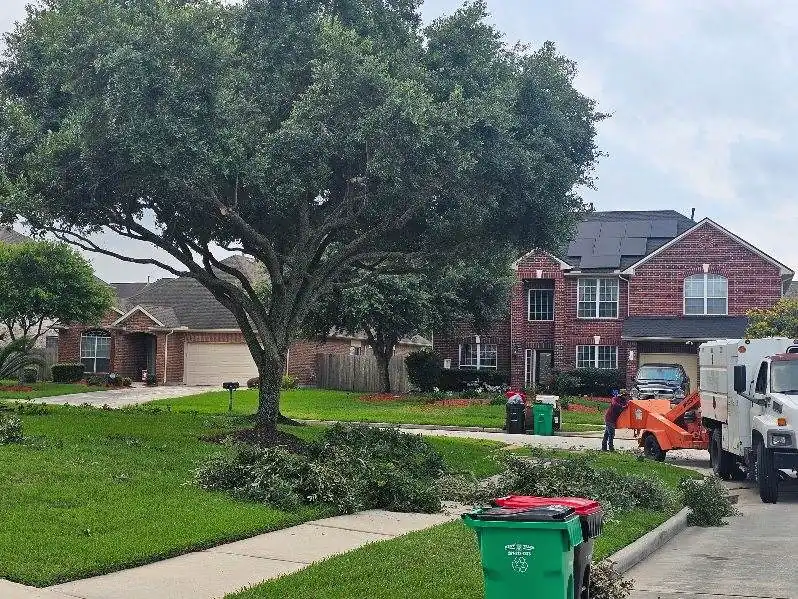
On an apartment community, office park or HOA common area, the people nearby add another layer. Residents, tenants, visitors and other contractors may not know a removal is under way unless the site is set up to tell them.
The safety standard
ANSI Z133 is the U.S. safety standard for arboricultural operations. It covers protective equipment, work zones, felling, rigging, cranes, electrical hazards and machines such as chippers. It is a standard, not a certification. OSHA has not issued a rule written for tree care; tree work falls under general industry rules, and TCIA reports that a federal rulemaking has been in progress.
How a removal site is controlled
- Site walk and plan. Before the work day, the scope notes the tree, the targets under it, access, overhead lines and the method: felling, sectional dismantling or crane.
- Job briefing. The crew reviews the plan, each person’s role, the drop zone and the signals they will use.
- Work zone and drop zone. Cones, tape and signs close the area. The drop zone covers everywhere a piece could land, bounce or roll, and is kept clear by a ground worker.
- Rigging check. Ropes, slings, blocks and lowering devices are inspected before use, and the rigging point in the tree is checked for decay.
- Traffic control. Parking rows and drive lanes are coned off, and vehicles are moved out of the drop zone.
- Piece by piece. Each limb or section is cut only when the ground crew is clear and ready.
- Final sweep. The area is checked for hung pieces, debris and damage before it reopens.
We do not publish a single drop zone distance. The right size depends on the tree’s height, the piece sizes, the slope and the rigging method, and it is set on site.
Electrical hazards
Removals near overhead lines need a plan before anyone climbs. Texas Health and Safety Code 752.004 bars work that could bring a person, tool or material within 6 feet of a high voltage line (over 600 volts) unless the line operator has been notified at least 48 hours ahead and a safety arrangement is in place. OSHA 1910.333 keeps unqualified workers and their conductive objects at least 10 feet from lines of 50 kV or less. Equipment that can reach toward the lines, such as a crane boom, keeps the same 10 feet.
When part of a tree is inside those distances, CenterPoint Energy or a line-clearance qualified crew does that part, and Strong Tree Service coordinates and works outside the minimum approach distances. Read power line safety for the full rules.
Weather stops
Wind changes how pieces swing and fall, wet bark changes friction on ropes and lightning ends climbing. OSHA’s line-clearance rule treats nearby thunderstorms and high winds as presumed too hazardous for that work, and the same reasoning applies to removals. A weather stop is a normal part of planning in Houston, not a missed day.
Storm-damaged trees
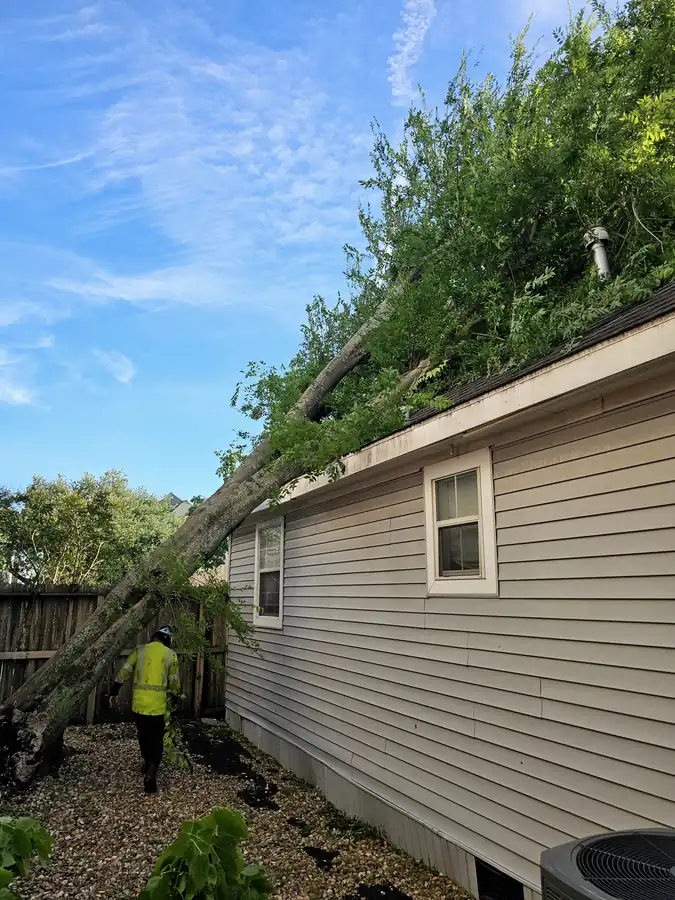
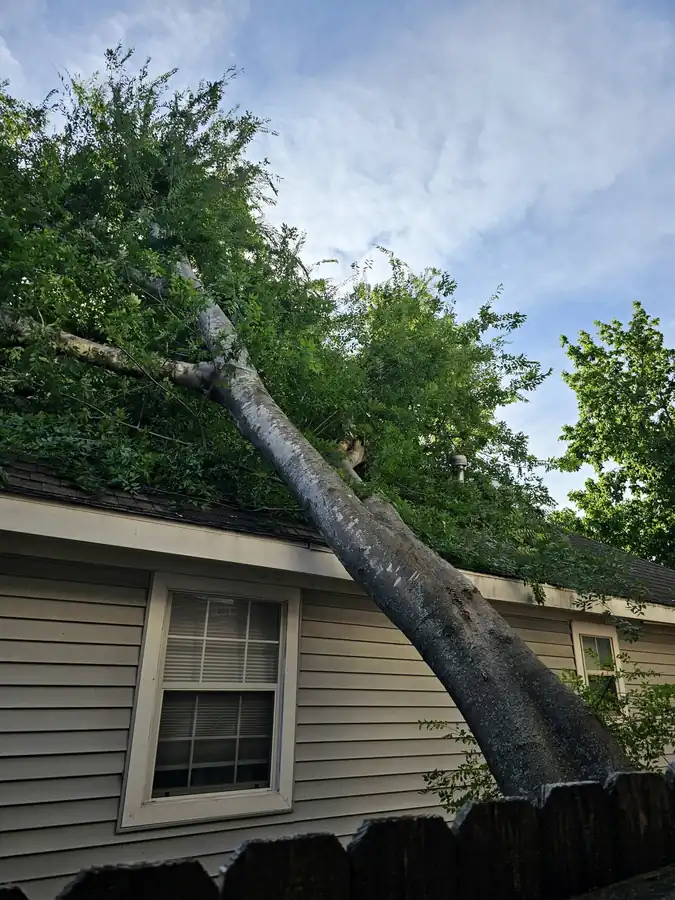
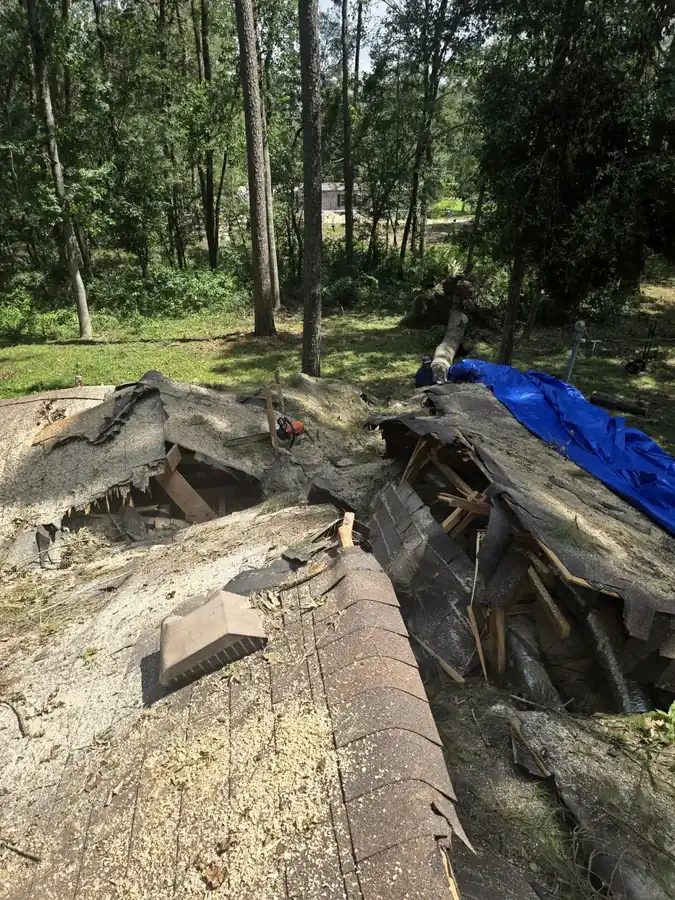
Trees broken or uprooted by a storm are under tension and compression that can release without warning. Downed lines may be tangled in them. For storm work, see our pages on emergency tree removal and storm safety and downed lines. Strong Tree Service keeps a 24/7 emergency tree removal line at (832) 525-1070.
What the property should prepare
| Item | Why |
|---|---|
| Resident or tenant notice | People avoid the closed areas and move cars on time |
| Vehicle moves | Cars near the tree are inside the drop zone |
| Access and gate codes | Trucks and the chip truck need a clear route |
| Amenity closures | Pools, courts and playgrounds under or near the tree stay empty |
| Underground utility information | Helps plan where pieces and stumps can be worked |
| A contact for the day | Quick answers keep the plan on track |
What a buyer should ask
- How will each tree come down: felled, dismantled or lifted by crane?
- Who keeps the drop zone clear, and how is it marked?
- Are there lines near the tree, and who handles that part?
- What happens if weather turns?
- Can you send a certificate of insurance and a W-9? Strong Tree Service sends both on request.
How Strong Tree Service plans removal safety
On the site walk our head foreman looks at the tree’s condition, the targets below it and the access. The written scope lists the trees, the work, access, cleanup, stump depth, schedule and price, along with the areas that close. The crew has about 15 years in the field. For tight sites, see limited-access and near-structure removal and crane and rigging removal, or return to tree removal. To get a removal scope with the safety plan written in, request a bid.
[1] Source in references below
[2] Source in references below
[3] Source in references below
[4] Source in references below
[5] Source in references below
[6] Source in references below
Frequently asked questions
How big is the drop zone around a tree removal?
It depends on the tree’s height, the size of each piece, the slope and the rigging method. It is set on site rather than by one fixed distance, and it covers everywhere a piece could land, bounce or roll.
Why are dead trees more dangerous to remove?
Dead wood loses strength and can break unexpectedly under rigging loads. Texas A&M guidance notes that dead pines become brittle 6 to 10 months after death, so older dead trees often call for more careful rigging or a crane.
Do residents need to be told before a removal?
Yes. Residents and tenants need to know which areas close and which cars must move. The scope lists those areas so the manager can send a clear notice.
Can you remove a tree that is touching a power line?
Not the part near the line. Texas law bars work within 6 feet of high voltage lines without an arrangement with the line operator, and OSHA keeps unqualified workers 10 feet away. CenterPoint Energy or a line-clearance qualified crew handles that part first.
References
Related reading
Request a bid