

Tree removal · Risk assessment
Tree risk assessment before removal
A removal decision should be explainable to a board, a resident or an insurer. A tree risk assessment turns “that tree looks bad” into a documented reason, with the options short of removal written down beside it.
What a tree risk assessment is
A tree risk assessment is a structured look at a tree to judge how likely it is to fail, what it would hit and how serious the result would be. ANSI A300 includes a part on tree risk assessment, and the International Society of Arboriculture (ISA) publishes a best management practice and a standard assessment form that many arborists use.
The point is not to find a reason to remove a tree. It is to see the risk clearly and pick the right response, which is often pruning, not removal.

The three factors
The ISA tree risk assessment method weighs three things together:
| Factor | The question it answers |
|---|---|
| Likelihood of failure | How likely is the tree, or a part of it, to break or fall in the time frame being considered? |
| Likelihood of impact | If it fails, how likely is it to hit a target such as a person, car, building or walkway? |
| Consequences | If it hits that target, how serious is the harm or damage? |
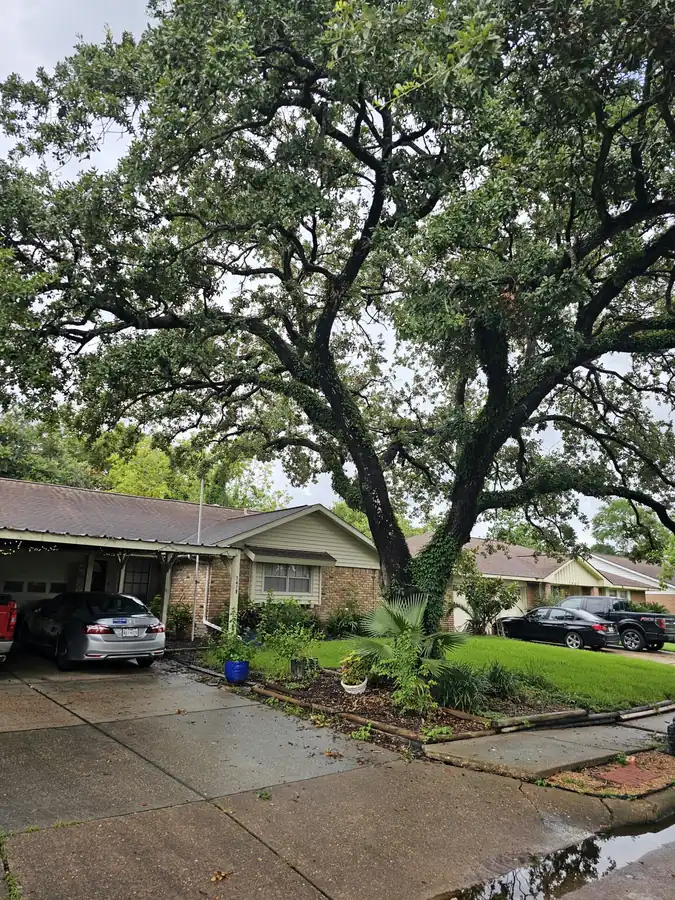
Those factors combine into an overall risk rating. A large dead limb over an empty corner of a field rates very differently from the same limb over a pool deck or a school bus stop. The target is as important as the tree.
Levels of assessment
The ISA describes levels of assessment that differ in depth:
- Limited visual assessment. A quick look, often from the ground or a vehicle, to find obvious defects across many trees. Useful for large properties and after storms.
- Basic assessment. A closer, ground-level inspection of one tree, walking around it and looking at the roots, trunk and crown, with simple tools.
- More detailed investigation. When a basic assessment raises questions it cannot answer, such as hidden decay in the trunk or root collar, further testing can follow.
For HOAs and portfolios, a limited visual review of every tree, followed by basic assessments of the trees it flags, is a practical way to set priorities. See tree inventory and risk assessment.
What an assessor looks at
- Dead wood and broken or hanging limbs.
- Cracks, splits and weak forks with included bark.
- Decay: cavities, soft wood, fungal conks or mushrooms at the base.
- Root problems: cut roots, soil heaving, lifting, grade changes and construction damage.
- Lean, especially a new lean or one with cracked soil on the opposite side.
- Disease and insects: for example, hypoxylon canker on stressed oaks or bark beetle signs on pines.
- Targets and occupancy: what is under the tree and how often people are there.
Our page on hazard tree signs explains these in plain language.
Options short of removal
A risk rating is followed by mitigation options. Common ones include:
- Pruning to remove dead, cracked or weak limbs.
- Reduction to shorten a heavy limb or lower the crown.
- Moving the target, such as relocating a bench, parking spot or play feature.
- Support systems for some weak forks or limbs, where suitable.
- Monitoring on a set schedule, with a recheck date.
- Removal when the risk cannot be brought to an acceptable level another way.
Some disease situations point toward removal. Texas AgriLife guidance on hypoxylon canker suggests considering removal when more than 15 percent of the canopy is affected, because the wood decays and can fail. Texas A&M guidance says pines with active bark beetle infestations are nearly impossible to save.
Who performs it
Ask who does the assessment and what credential they hold. Safety and training credentials are available on request. He looks at each tree in a removal scope on the site walk and records the reason for the recommendation and the options considered.
What the board or manager should receive
- The tree’s location and species.
- The defects found and the target below.
- The recommended action and the reason.
- Options considered short of removal.
- A recheck date for trees that stay.
That record helps when residents ask why a tree is coming down, and when the board needs to show it acted on a known problem.
How Strong Tree Service uses risk assessment in a scope
The site walk is where risk is judged. The written scope lists each tree, the work and its reason, along with access, cleanup, stump depth, schedule and price. Trees that do not need removal are scoped for pruning or monitoring instead. See tree removal for the full service, and permits in Houston for the approval step that may follow. To have trees on your property looked at before a decision, request a bid.
[1] Source in references below
[2] Source in references below
[3] Source in references below
Frequently asked questions
Does a risk assessment always end in removal?
No. Many assessments end in pruning, reduction, moving a target or monitoring. Removal is recommended when the risk cannot be lowered enough another way.
Why does the target matter so much?
The same defect is a very different risk over an empty field than over a pool deck or parking space. The ISA method weighs the likelihood of hitting a target and the consequences, not just the tree’s condition.
How do we know a removal recommendation is not a sales pitch?
Ask for the reason in writing, the defects found, the target and the options considered short of removal. A clear record lets the board judge the recommendation for itself.
How often should trees on an HOA property be assessed?
There is no single schedule. A practical approach is a regular visual review of all trees, closer checks on trees with known defects and a review after major storms.
References
Related reading
Request a bid