
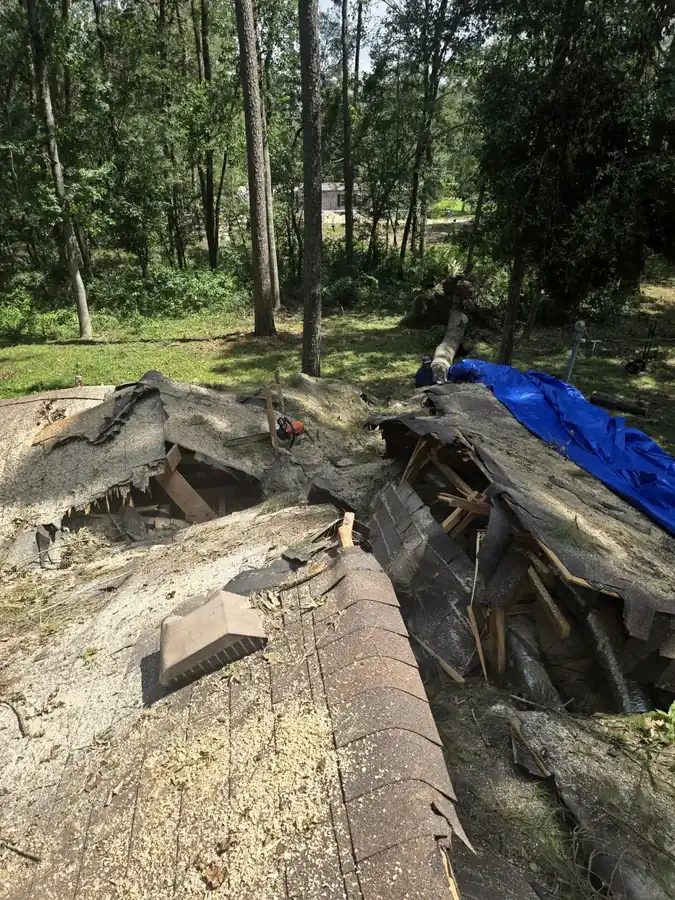
Tree removal · Hazard tree signs
Hazard tree signs: what to look for before a tree fails
Most trees that fail show warning signs first. Property managers, board members and residents who know what to look for can get a tree inspected before it drops a limb on a car or a walkway.
Defect plus target equals risk
A tree becomes a hazard when it has a defect that could cause failure and something or someone it could hit. The ISA tree risk assessment method weighs the likelihood of failure, the likelihood of impact on a target and the consequences together. A cracked limb over an empty field and the same crack over a playground are not the same problem.
Use the signs below to decide which trees need a closer look. None of them alone means a tree must come down. They mean a trained person should inspect it. See tree risk assessment for how that inspection works.

Signs in the crown
- Dead branches, especially large ones over walks, drives, parking and roofs. Texas A&M Forest Service lists removing dead, weak and diseased branches as routine pruning.
- Hanging or broken limbs caught in the canopy after a storm, sometimes called hangers.
- Thinning crown or dieback from the top down, which can point to root problems, disease or insects.
- Sudden leaf color change in summer. Texas A&M Forest Service describes red oaks with oak wilt turning bright, autumn-like colors out of season.
- Pine needles fading yellow to red. Texas A&M guidance notes this can happen within about three weeks of a bark beetle attack in hot, dry summers.
Signs on the trunk and limbs
- Cracks and splits, especially vertical cracks or cracks below a fork.
- Weak forks where two stems of similar size grow tight together with bark pinched between them.
- Cavities and soft wood.
- Peeling bark with gray or black crusts underneath on stressed oaks, which can be hypoxylon canker. Texas AgriLife guidance suggests considering removal when more than 15 percent of the canopy is affected, because the wood decays.
- Fungal conks (shelf-like growths) on the trunk or near the base. The Texas A&M Plant Clinic advises having a tree with Ganoderma conks inspected by a trained professional for structural integrity.
- Pitch tubes and boring dust on pines, signs of bark beetles. Southern pine beetle pitch tubes sit in bark crevices, and Ips pitch tubes sit on the flat bark plates. See southern pine beetle and Ips engraver beetles.
Signs at the base and roots
- Mushrooms at the base, which can signal root or butt decay.
- Cut, crushed or buried roots from trenching, paving, added fill or parking. The City of Houston’s landscape brochure warns that more than 2 inches of added soil can kill a tree.
- Soil heaving or cracking on the side opposite a lean.
- A new lean, or a lean that has changed after a storm or heavy rain.
- Hollow sound when the trunk is tapped, which can indicate internal decay or, in some cases, Formosan termites. Texas A&M AgriLife reports these termites attack more than 50 tree species.
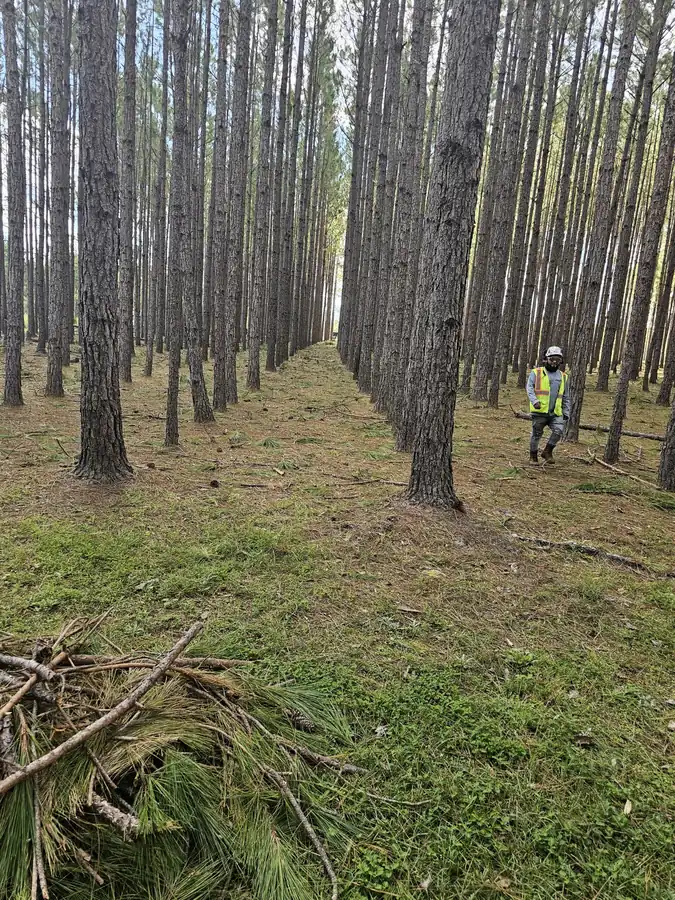
Dead trees
A dead tree near a target should be dealt with promptly. Texas A&M guidance notes that dead pines become brittle 6 to 10 months after death, which makes them harder and more dangerous to remove the longer they stand.
Houston conditions that raise the stakes
- Hurricane and tropical storm season puts heavy wind and rain on weak trees. See hurricane season prep.
- Drought stresses trees and opens the door to hypoxylon canker and bark beetles. See drought stress and live oak care.
- Saturated soil after heavy rain can loosen roots, especially on trees with root damage.
- Construction near trees cuts and compacts roots. See construction root protection.
What to do when you see a sign
- Keep people and cars clear of anything that looks ready to fall.
- Photograph the tree and the defect, with something nearby for scale.
- Note the target: walkway, parking row, roof, playground.
- Call for an inspection. If a tree or limb is touching a power line, do not approach it. See branches touching power lines.
- If it has already failed, go to emergency tree removal. Strong Tree Service keeps a 24/7 emergency tree removal line at (832) 525-1070.
How Strong Tree Service follows up
Safety and training credentials are available on request. On the site walk he looks at the trees you flag and the targets under them, and the written scope lists the recommended work and the reason: pruning, monitoring or removal. See tree removal for the full service. To have a tree with warning signs looked at, request a bid.
[1] Source in references below
[2] Source in references below
[3] Source in references below
[4] Source in references below
[5] Source in references below
[6] Source in references below
[7] Source in references below
Frequently asked questions
What makes a tree dangerous?
A defect that could cause failure, such as decay, cracks, dead limbs, root damage or a changing lean, combined with a target it could hit. The ISA method weighs the likelihood of failure, the likelihood of impact and the consequences together.
Do mushrooms at the base mean the tree is dying?
Not always, but they can signal decay in the roots or lower trunk, which is hard to see. A tree with mushrooms or conks at the base should be inspected for structural soundness.
Our pines are turning red. Are they dangerous?
Red or fading needles on pines can be a sign of bark beetle attack. Texas A&M guidance says infested pines are nearly impossible to save, and dead pines become brittle 6 to 10 months after death. Have them inspected and plan removal near targets.
Is a leaning tree always a hazard?
No. Many trees grow with a lean and stay stable. A new lean, a lean that changed after a storm or soil cracking on the opposite side are warning signs that need an inspection.
References
- ISA, Tree Risk Assessment Form
- Texas A&M Forest Service, Pruning mature trees
- USDA Forest Service and Texas Forest Service, Identify and Manage Oak Wilt in Texas, SR-1
- Texas AgriLife Extension, Hypoxylon canker management, PLPA-116
- Texas Cooperative Extension and Texas Forest Service, Landowner’s Guide: Pine Bark Beetles, 2003
- Texas A&M AgriLife Extension, Formosan subterranean termites, E-367
- City of Houston, Landscape Regulations for Development, 2009
Related reading

Request a bid