

HOA · Tree removal
HOA tree removal in Houston: common area removals, permits and homeowner requests
Removing a common area tree is a board decision that residents will notice. A written reason, the right permits and a plan for the stump and the replacement make the decision easy to explain and the work easy to approve.
When an HOA tree should come out
Removal is the last option, not the first. A common area tree is usually a removal candidate when it is:
- Dead, or mostly dead, with no reasonable chance of recovery.
- Failing, with a split trunk, major decay, a cracked union or a lifting root plate.
- High risk after an arborist’s assessment, because of what it would hit if it failed: homes, streets, play areas or the amenity center.
- In conflict with a structure, such as roots lifting a wall or a trunk pressing on a building, where pruning cannot solve the problem.
- Near power lines in a way the utility has decided requires removal.
Trees that are merely messy, shading a lawn or disliked by one resident are a different conversation. Many can be pruned instead. See tree trimming for what pruning can do.
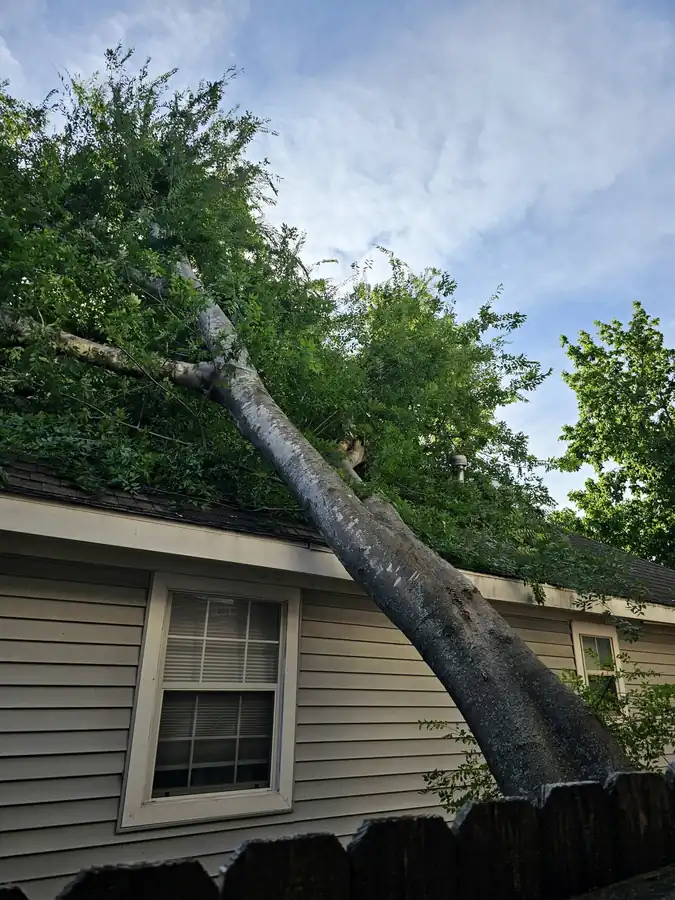
Assessment first, in writing
A board that removes a tree without a stated reason will hear about it. A written reason for each tree helps the board explain the decision at a meeting, in minutes and to the resident whose view changes.
Strong Tree Service’s head foreman looks at each tree proposed for removal and gives a written recommendation with the reason. For a community-wide picture, a tree inventory and risk assessment ranks every common area tree, so removals are planned in order of priority instead of complaint.
Permits
Most common area trees are on association land and do not need a city permit to remove. Trees on public land are different.
Some HOA entrances and medians sit on public right-of-way, so confirm who owns the land before planning a removal. Other cities and the counties have their own rules. The permits in Houston and the counties page explains each. The bid should say which permits apply and who files them.
Trees near power lines
Strong Tree Service is not a utility line-clearance contractor. If any part of a tree is inside the minimum approach distance of an energized line, that part goes to CenterPoint Energy or a line-clearance qualified crew, and we coordinate the rest of the removal around their work.
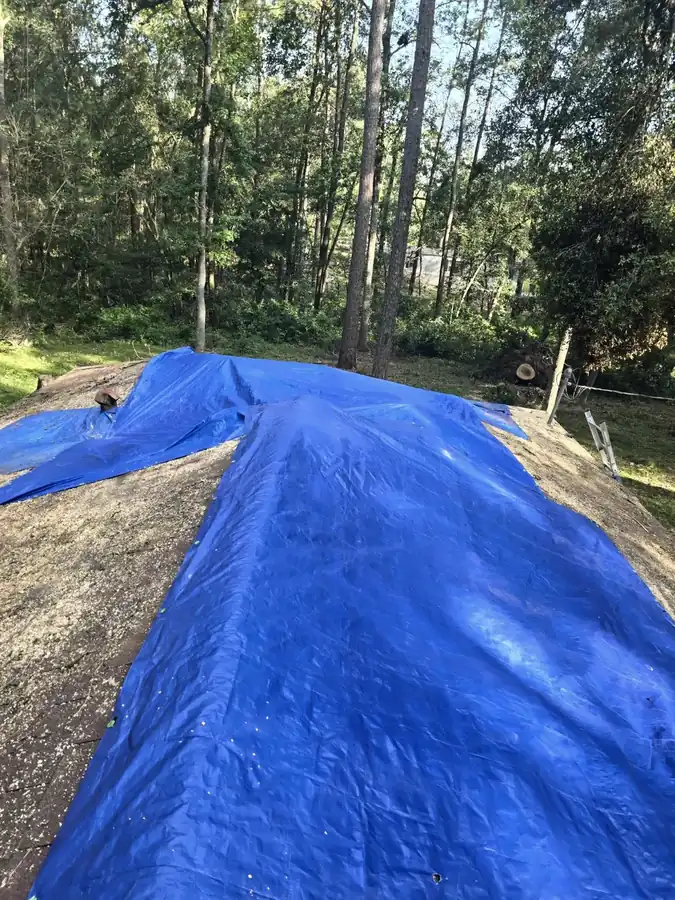
The work day
On the day of removal:
- The crew sets cones and tape around the drop zone and confirms that cars have been moved.
- The tree is taken down whole where there is room, or in sections lowered piece by piece where it is close to homes, fences or the amenity center.
- Brush is chipped and wood is hauled or left as the scope says.
- The site is cleaned up and walked with your contact.
Residents should get a notice before the work. See resident notices for templates.
Stumps and replacement
The scope states what happens to the stump: left at a stated height, or ground to a stated depth. Grinding goes below grade, so a Texas 811 utility locate should be requested before it starts.
Many associations replace removed trees under their landscape guidelines. A replacement plan, naming the species, size and location, helps residents see that the canopy is being renewed, not just cut down. Our tree removal page covers stump grinding in more detail.
Homeowner lot trees
Trees on a homeowner’s lot are usually the owner’s responsibility, but the association often controls whether they can be removed. Many HOAs require written architectural review approval before an owner removes a tree. Residents should check with management before hiring anyone. The homeowner approval guide walks through the steps, and common area vs homeowner trees explains who owns which tree.
Records for the board
Every removal should leave a record: the tree, its location, the written reason, any permit, and the itemized invoice. If the board needs photos for its files or for an insurance question, say so at the site walk so the scope lists them. Those records answer the question “why did the HOA take down that tree?” months or years later.
What the board should ask any removal bidder
- What is the written reason for each removal?
- Who owns the land, and does any tree need a permit?
- Are any trees near energized lines, and who handles them?
- How will the tree come down near homes and fences?
- What happens to the stump, and will an 811 locate be requested?
- Where do the chips and wood go?
How Strong Tree Service scopes HOA removals
It starts with a site walk with the manager or a board member. You then get a written, itemized scope by work zone: each tree, the reason and the work, access and parking, cleanup, stump depth, the schedule and the price. The board can approve the whole scope or only the urgent trees. The job ends with cleanup and a final walkthrough with your contact. When you are ready, request a bid. For a tree that has already fallen, call the 24/7 emergency line at (832) 525-1070 or see HOA storm cleanup.
Safety and training credentials are available on request, and the crew has about 15 years in the field. A certificate of insurance and a W-9 are sent on request. We serve associations in Houston, Katy, Spring, Sugar Land and The Woodlands.
[1] Source in references below
[2] Source in references below
[3] Source in references below
[4] Source in references below
Frequently asked questions
Do I need HOA approval to remove a tree on my lot?
Often yes. Many associations require written architectural review approval before an owner removes a tree. Check your design guidelines and ask management in writing before hiring anyone.
Do we need a city permit to remove a tree in Houston?
A permit is required to remove any tree on City of Houston property, including rights-of-way, medians and setbacks, and it must be posted 20 days before work. Common area trees on association land usually are not city trees, but confirm who owns the land.
Who pays if an HOA tree falls on a home?
Usually the owner of the tree, set by trunk location and the governing documents, and subject to insurance. Get legal advice for a dispute.
Can you remove a tree touching a power line?
Not the part near the line. CenterPoint Energy or a line-clearance qualified crew handles anything inside the minimum approach distance, and we remove the rest of the tree once the line is clear.
Will you grind the stump?
Stump grinding is quoted as its own line item, with the depth stated in the scope. A Texas 811 locate should be requested first, since Texas law requires notice at least two working days before excavation.
References
Go deeper
Related reading
Request a bid