

Resources · FAQ
Tree service FAQ for Houston HOAs, property managers and businesses
Straight answers to the questions boards, managers, contractors and residents ask about tree work in Greater Houston. Every rule and figure names its source, and every answer points to the page that goes deeper.
This page collects the questions we hear on site walks across Houston, Katy, Spring, Sugar Land and The Woodlands, plus the questions other tree companies leave unanswered. Answers are short on purpose. Where a rule or figure appears, the source is named so your board, manager or insurer can check it.
Nothing here is legal advice, and no answer replaces a look at the actual trees. If your question is about a specific property, the fastest route is a site walk and a written scope.
Jump to a topic
- Pruning and trimming
- Tree removal and stumps
- Plant health care, disease and insects
- Storms and emergencies
- Power lines and right-of-way
- HOA boards and residents
- Commercial properties and contractors
- Insurance, documents and bids
- Pricing and scheduling
- About Strong Tree Service
Pruning and trimming
When should trees be pruned in the Houston area?
Dead, broken and weak branches can be removed at any time of year. For oaks, timing matters: Texas A&M Forest Service advises against pruning or wounding oaks from February through June and points to the heat of summer or the cold of winter as the safer windows. For most other species, pruning shortly before spring growth helps wounds close. Our Houston seasonal calendar lays out the year month by month.
Source: Texas A&M Forest Service, Prevent the spread of oak wilt in Texas this spring (https://tfsweb.tamu.edu/prevent-the-spread-of-oak-wilt-in-texas-this-spring)
Can you prune our live oaks in spring?
Only when a limb is a safety hazard. Texas A&M Forest Service advises no pruning or wounding of oaks from February through June because of oak wilt, and says to paint every oak wound in any season. Routine oak pruning is scheduled outside that window. See oak pruning and oak wilt season and live oak pruning in Houston.
Source: Texas A&M Forest Service, Oak wilt disease threatens Texas oaks in spring (https://tfsweb.tamu.edu/oak-wilt-disease-threatens-texas-oaks-in-spring)
How much of a tree will you take off?
Only what the stated objective needs. Texas A&M Forest Service guidance is to remove no more than 25 percent of the crown at one time, and usually less on mature trees. TCIA notes that the 2017 ANSI A300 pruning revision moved away from a fixed percentage and toward amounts set by objective, species, age and condition. We write the objective and the amount into the scope for each tree or zone.
Source: Texas A&M Forest Service, Pruning mature trees (https://tfsweb.tamu.edu/es/elibrary-item/pruning-mature-tree)
Source: TCIA, ANSI A300 Pruning Standard Changes (https://tcia.org/TCIA/Blog_Items/2016/ANSI_A300_Pruning_Standard_Changes_in_Public_Review_Period.aspx)
Do you top trees?
No. TCIA’s summary of ANSI A300 Part 1 lists topping as an unacceptable practice, because it leaves large wounds and weakly attached regrowth. When a tree is too large for its space, a reduction cut back to a suitable lateral branch is the standard alternative. Our ANSI A300 pruning standards page explains the cuts.
Source: TCIA, ANSI A300 Part 1 Pruning overview (https://treecareindustryassociation.org/business-support/ansi-a300-standards/part-1-pruning/)
Can improper pruning harm a tree?
Yes. TCIA’s summary of ANSI A300 Part 1 names topping, lion’s tailing (stripping inner branches and leaving foliage only at the ends) and over-thinning palms as unacceptable practices that can injure trees. Poor cuts also leave wounds that decay and, on oaks in spring, can open the door to oak wilt. Ask any contractor to state pruning type and amount in A300 terms.
Source: TCIA, ANSI A300 Part 1 Pruning overview (https://treecareindustryassociation.org/business-support/ansi-a300-standards/part-1-pruning/)
What types of pruning are there?
The common types are cleaning (removing dead, diseased and broken branches), thinning, raising (lifting low limbs for clearance), reduction (shortening limbs to reduce size or load) and structural pruning on young trees. Each has a different purpose, and a good scope names which one applies to which tree. Our types of pruning page walks through each, and the main tree trimming page covers how we scope the work.
What is deadwooding?
Deadwooding is removing dead branches, part of what the standards call crown cleaning. Texas A&M Forest Service lists removing weak, diseased or dead branches as routine pruning that can be done in any season. On large shade trees over parking lots, walkways and roofs, it is often the first item in a maintenance cycle.
Source: Texas A&M Forest Service, Pruning mature trees (https://tfsweb.tamu.edu/es/elibrary-item/pruning-mature-tree)
What is structural pruning, and why do young trees need it?
Structural pruning shapes a young tree so it grows one dominant trunk with well-spaced, well-attached branches. Done early, it prevents the weak forks and heavy limbs that fail in storms years later, and the cuts stay small. Many maintenance programs prune young trees on shorter cycles for this reason; see pruning cycles and standards.
How does pruning reduce risk and help with tree problems?
Risk mitigation is one of the pruning objectives ANSI A300 recognizes: removing dead limbs, reducing heavy limbs over roofs, roads and parking, and correcting weak structure. Pruning is also part of managing several Houston-area problems; Texas A&M guidance includes pruning out fusiform rust galls on pines and removing dead branches on trees with hypoxylon canker when 15 percent or less of the canopy is affected. No pruning can guarantee a tree will not fail, but scheduled pruning removes many defects before a storm does. For how crews stay safe doing it, see pruning safety.
Source: TCIA, ANSI A300 Part 1 Pruning overview (https://treecareindustryassociation.org/business-support/ansi-a300-standards/part-1-pruning/)
Source: Texas AgriLife Extension, Hypoxylon canker management, PLPA-116 (https://plantclinic.tamu.edu/wp-content/uploads/2010/09/Hypoxylon-Fact-Sheet3.pdf)
Source: Texas Plant Disease Diagnostic Lab, Fusiform rust (https://plantclinic.tamu.edu/calendar2018/fusiformrust)
Tree removal and stumps
When should a tree be removed?
When its risk cannot be brought to an acceptable level by pruning or other means, or when disease management calls for it. Texas A&M guidance points to removal for red oaks diseased with oak wilt, pines with active bark beetles, and trees where hypoxylon canker affects more than 15 percent of the canopy. The main tree removal page explains how we scope removals.
Source: USDA Forest Service and Texas Forest Service, Identify and Manage Oak Wilt in Texas, SR-1 (https://agrilifeextension.tamu.edu/wp-content/uploads/2025/04/TFS_OakWilt_v4.pdf)
Source: Texas AgriLife Extension, Hypoxylon canker management, PLPA-116 (https://plantclinic.tamu.edu/wp-content/uploads/2010/09/Hypoxylon-Fact-Sheet3.pdf)
Is the tree actually dangerous?
A tree risk assessment answers that. The method behind ANSI A300 Part 9 looks at the likelihood that a tree or part fails, the likelihood it hits a target such as a building, road or play area, and the consequences. Size alone does not make a tree dangerous; decay, cracks, dead or hanging limbs, root damage and lean combined with a target do. See tree inventory and risk assessment.
Source: TCIA, ANSI A300 Part 9 Tree Risk Assessment (https://treecareindustryassociation.org/business-support/ansi-a300-standards/part-9-tree-risk-assessment-a-tree-failure/)
Do you offer tree risk assessments?
Our risk reviews are led by the head foreman, and we describe them as arborist assessments. ISA offers a separate credential, the Tree Risk Assessment Qualification, for assessors trained in its formal method. If your board or insurer requires that credential for a specific tree, tell us at the site walk.
Source: ISA, Tree Risk Assessment Qualification (https://www.isa-arbor.com/Credentials/Types-of-Credentials/ISA-Tree-Risk-Assessment-Qualification)
How do we know a removal recommendation is not a sales pitch?
Ask for the reasoning in writing: the defect, what the tree could hit, and which options short of removal were considered, such as reduction pruning or moving the target. A recommendation built on the ANSI A300 Part 9 approach can be checked by a second arborist. Our scopes state why each removal is recommended.
Source: TCIA, ANSI A300 Part 9 Tree Risk Assessment (https://treecareindustryassociation.org/business-support/ansi-a300-standards/part-9-tree-risk-assessment-a-tree-failure/)
Can a tree next to a building come down without a crane?
Often, yes. A climber can dismantle the tree in sections and lower each piece on ropes so nothing free-falls onto the roof, fence or pavement. Whether rigging alone or a crane is the safer method depends on the tree, the structure and the access, and that choice is made at the site walk. See limited access and near-structure removal, crane and rigging removal and tree removal safety.
Do we need a permit to remove a tree in Houston?
For any tree on City of Houston property, including rights-of-way, esplanades, parks and certain setbacks, yes. The Houston Permitting Center lists about 10 business days for processing, a permit valid for one year, and posting at the site 20 days before work. Trees on private property may still need HOA approval; see permits in Houston and the counties.
Source: Houston Permitting Center, Tree Removal and Trimming Permit PRD1001 (https://www.houstonpermittingcenter.org/prd1001)
What is stump grinding, and how deep does it go?
A stump grinder chips the stump and surface roots below grade, leaving a mix of chips and soil. No standard sets one fixed depth; it depends on what goes there next, such as sod, a new tree or paving. We write the grinding depth and whether grindings are hauled into the scope. See stump grinding.
Does the stump have to come out, and should it be ground or pulled?
Not always. Grinding makes sense when a stump is a trip or mowing hazard, will sprout, or blocks replanting; pulling the whole root ball is mainly a construction task where a footprint must be cleared, and it disturbs far more soil. If an oak is cut, Texas A&M Forest Service advises painting the fresh stump in any season to keep oak wilt beetles away.
Source: USDA Forest Service and Texas Forest Service, Identify and Manage Oak Wilt in Texas, SR-1 (https://agrilifeextension.tamu.edu/wp-content/uploads/2025/04/TFS_OakWilt_v4.pdf)
Do you call 811 before stump grinding?
Grinding is digging, and buried lines are common around Houston properties. The Railroad Commission of Texas says to notify 811 at least two working days before excavation, and a bid should say whether locates will be requested. Our scopes note it on every grinding job.
Source: Railroad Commission of Texas, 811 Day (https://rrc.texas.gov/news/081120-811-day)
If roots are cut, will the tree die?
Not always, but root loss stresses a tree and makes it a target for bark beetles and hypoxylon canker. City of Houston development guidance says to protect at least 75 percent of the critical root zone, add no more than 2 inches of fill over roots, and bore or hand dig for utilities near trees. Plan root cuts with an arborist before trenching or paving.
Source: City of Houston, Landscape Regulations for Development, 2009 (https://www.houstontx.gov/planning/DevelopRegs/docs_pdfs/tree_shrub.pdf)
What happens to the wood and chips?
It depends on the job and the site, so the scope says it in plain words: hauled away, chipped on site, or left in place, and where chips go. If CenterPoint Energy removes a tree from its lines, the utility leaves the wood for the property owner, so plan for cleanup after its crew leaves.
Source: CenterPoint Energy, Tree Trimming and Removal (https://www.centerpointenergy.com/en-us/Safety/Pages/Tree-Trimming-Removal.aspx)
Plant health care, disease and insects
What is plant health care?
Plant health care is a planned approach to keeping trees and shrubs healthy: regular inspection, diagnosis of problems, and the least disruptive fix that works, from pruning and mulching to watering and, where needed, treatment. It favors catching problems early over reacting after a tree declines. The disease and insect pages linked in this section explain the common Houston-area problems one by one.
Are tree treatments safe, and who applies them?
In Texas, anyone applying a pesticide to trees, shrubs or turf for hire must hold a Texas Department of Agriculture license, and the product label sets the rate, timing and where it may be used. When a tree needs a chemical treatment, it is applied per label by properly licensed applicators where Texas law requires a license, and they can explain re-entry times for residents and pets. Our role is the assessment, the pruning and removal side of the plan, and coordinating the rest. Ask for the applicator’s TDA license number before any application.
Source: Texas Department of Agriculture, Applying Pesticides to Lawns, Trees and Ornamentals (https://texasagriculture.gov/Regulatory-Programs/Pesticides/Agricultural-Applicators/Applying-Pesticides-to-Lawns-Trees-Ornamentals)
Can oak wilt be cured?
No. Texas A&M Forest Service says management will not cure oak wilt but can greatly reduce losses: remove diseased red oaks, trench to break root connections, and treat high-value oaks with propiconazole injection, applied by trained applicators. Speed matters, since spread through shared live oak roots averages about 75 feet per year. See oak wilt.
Source: USDA Forest Service and Texas Forest Service, Identify and Manage Oak Wilt in Texas, SR-1 (https://agrilifeextension.tamu.edu/wp-content/uploads/2025/04/TFS_OakWilt_v4.pdf)
Source: Texas A&M Forest Service, Oak wilt FAQ (https://tfsweb.tamu.edu/oakwiltfaqs)
Is oak wilt in the Houston area?
Texas A&M Forest Service reports oak wilt in 76 Texas counties, mostly in Central Texas. We have not confirmed a published finding for Harris, Fort Bend or Montgomery County, so we do not claim one. The prevention rules still apply here: no oak wounding February through June, and paint every oak wound.
Source: Texas A&M Forest Service, Oak wilt FAQ (https://tfsweb.tamu.edu/oakwiltfaqs)
Our pines are turning red. Can they be saved?
Usually not once bark beetles have moved in. Texas A&M guidance says it is nearly impossible to save an infested pine, so the focus is removing trees with live beetles and protecting the rest from stress. In hot, dry summers a crown can fade in as little as three weeks. See southern pine beetle.
Source: Texas Cooperative Extension and Texas Forest Service, Landowner’s Guide: Pine Bark Beetles (https://agrilifeextension.tamu.edu/wp-content/uploads/2025/06/Pine-Bark-Beetles.pdf)
Why does our oak have peeling bark with gray or black patches?
That can be hypoxylon canker, a fungus that takes over trees already weakened by drought, root damage or construction. Texas A&M guidance says to consider removal when more than 15 percent of the canopy is affected, because the wood rots and can fail. See hypoxylon canker.
Source: Texas AgriLife Extension, Hypoxylon canker management, PLPA-116 (https://plantclinic.tamu.edu/wp-content/uploads/2010/09/Hypoxylon-Fact-Sheet3.pdf)
What is the black coating on our crape myrtles?
It is often sooty mold, a fungus growing on honeydew left by sap-feeding insects such as crape myrtle bark scale or aphids. Texas A&M landscape guidance is to manage the insect, because the mold fades once the honeydew stops. See sooty mold and crape myrtle diseases.
Why do the leaves have spots or rust-colored marks?
Leaf spots on Houston shrubs and trees are commonly fungal, such as Entomosporium leaf spot on photinia and Indian hawthorn, or anthracnose on oaks and sycamores in wet springs. Swollen orange galls on pine branches are a different problem, fusiform rust. A diagnosis decides whether anything needs doing, since many leaf diseases are cosmetic.
Source: Texas Plant Disease Diagnostic Lab, Fusiform rust (https://plantclinic.tamu.edu/calendar2018/fusiformrust)
Is emerald ash borer in Houston?
Not as of June 2026. Texas A&M Forest Service lists 40 confirmed Texas counties, and Harris, Fort Bend and Montgomery are not among them, though the insect has reached Hardin County. Check the current list before moving ash wood.
Source: Texas A&M Forest Service, Emerald ash borer (https://tfsweb.tamu.edu/eab/)
Can we move ash, oak or beetle-killed pine wood off the property?
Ash wood and hardwood firewood may not leave a county quarantined for emerald ash borer except as the Texas Department of Agriculture allows. For oak wilt, Texas A&M Forest Service says never to store unseasoned wood from diseased red oaks near healthy oaks, and to cover it with clear plastic or burn it before spring. Wood from pines with live beetles should be dealt with quickly, by burning where allowed, chipping or tarping it in the sun, and laurel wilt wood should not be moved for any use.
Source: Texas Department of Agriculture, 4 TAC 19.700 to 19.703, via Cornell LII (https://www.law.cornell.edu/regulations/texas/4-Tex-Admin-Code-SS-19-700)
Source: USDA Forest Service and Texas Forest Service, Identify and Manage Oak Wilt in Texas, SR-1 (https://agrilifeextension.tamu.edu/wp-content/uploads/2025/04/TFS_OakWilt_v4.pdf)
Source: Texas Cooperative Extension and Texas Forest Service, Landowner’s Guide: Pine Bark Beetles (https://agrilifeextension.tamu.edu/wp-content/uploads/2025/06/Pine-Bark-Beetles.pdf)
Why are our redbay or sassafras trees dying so fast?
That pattern fits laurel wilt, a disease carried by the redbay ambrosia beetle, which Texas A&M AgriLife has reported in Kingwood in Harris County. Affected trees wilt and die quickly. Do not move the wood off site; chipping is generally considered safe. See laurel wilt.
Source: AgriLife Today, Laurel wilt a growing problem in Texas (http://agrilifetoday.tamu.edu/2022/04/27/laurel-wilt-a-growing-problem-in-texas/)
Our palms are browning from the top. What is happening?
One serious cause is lethal bronzing, a disease spread by a planthopper. Under the Texas Department of Agriculture quarantine described by Texas A&M AgriLife, susceptible palms within 1 mile of an infected palm stay in place for 6 months and are treated for the insect. A lab test confirms it; see lethal bronzing of palms.
Source: Texas A&M AgriLife Extension, Lethal Bronzing in Palm, PLPM-PU-047 (https://texasagriculture.gov/Portals/0/images/ACP/Palms/lethal-bronzing-in-palm-11.pdf)
How can we tell if a tree is dying?
Warning signs include thinning or dying crown tips, bark falling off, cracks, mushrooms or conks at the base, small resin tubes on pine bark, and leaf scorch that returns each year. Conks can signal decay such as Ganoderma butt rot or Armillaria root rot, while ooze from a crack is often slime flux, which is usually less serious. Confirm with a diagnosis before deciding; a ground-level review on the site walk is the starting point.
Source: Texas Cooperative Extension and Texas Forest Service, Landowner’s Guide: Pine Bark Beetles (https://agrilifeextension.tamu.edu/wp-content/uploads/2025/06/Pine-Bark-Beetles.pdf)
How do we protect trees during a Houston drought?
Texas A&M guidance for stressed trees is deep, slow watering under the canopy during drought, about 1 to 4 inches every 7 to 10 days, after checking that the soil is actually dry. Mulch rings help hold moisture and keep mowers off the trunk. Drought-stressed trees are the ones bark beetles and hypoxylon canker attack first.
Source: Texas Cooperative Extension and Texas Forest Service, Landowner’s Guide: Pine Bark Beetles (https://agrilifeextension.tamu.edu/wp-content/uploads/2025/06/Pine-Bark-Beetles.pdf)
What common mistakes damage trees on managed properties?
The most common ones are mower and string trimmer wounds at the base, soil or mulch piled against the trunk or over roots, and soil compaction from construction traffic. Texas A&M guidance recommends trunk guards and mulched rings to keep equipment away. These injuries often show up years later as decline or decay.
Source: Texas Cooperative Extension and Texas Forest Service, Landowner’s Guide: Pine Bark Beetles (https://agrilifeextension.tamu.edu/wp-content/uploads/2025/06/Pine-Bark-Beetles.pdf)
Storms and emergencies
What should we do first if a tree falls on a building or power line?
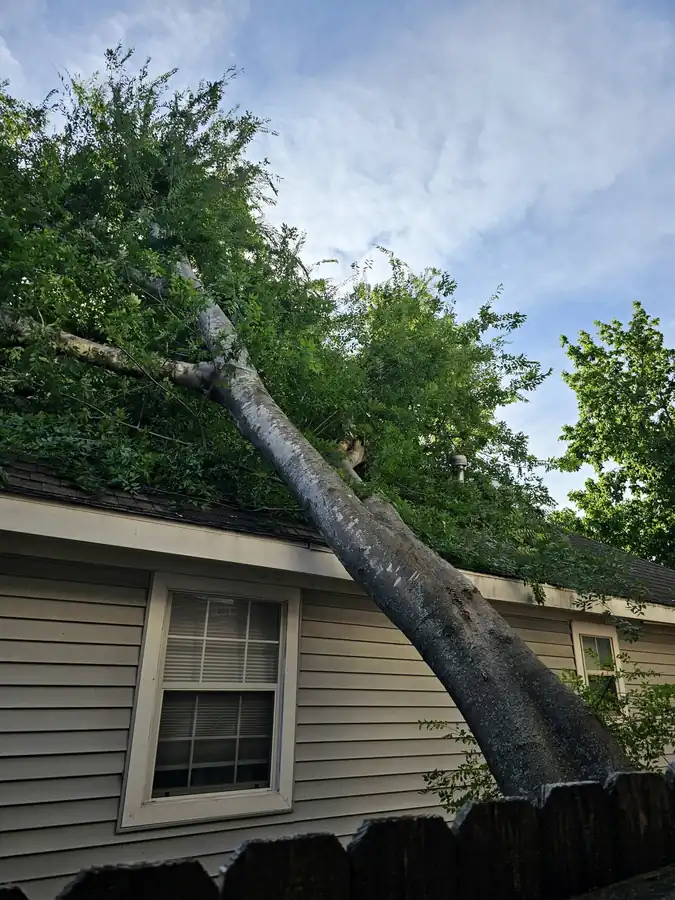
Keep everyone away and assume any line it touches is live. Call 911 if anyone is hurt or a line is down, and call CenterPoint Energy about the line. Do not touch the tree, the line or anything in contact with them. Our storm safety and downed lines page covers the next steps.
Source: CenterPoint Energy, Power restoration and safety (https://centerpointenergy.com/en-us/safety/pages/power-restoration_safety-information.aspx)
Do you offer 24/7 emergency tree removal?
Yes. Our 24/7 emergency tree removal line is (832) 525-1070. After a major storm, work is triaged by hazard, so arrival depends on conditions and the order of priorities. See emergency tree removal.
Can crews work while the storm is still going?
No. OSHA bars line-clearance tree work in thunderstorms, high winds, snow and ice, and the same caution applies to any tree work. Crews start once winds drop and the site is safe to enter. Until then, keep people out of the area under damaged trees.
Source: OSHA, 29 CFR 1910.269 (https://www.osha.gov/laws-regs/regulations/standardnumber/1910/1910.269_2)
In what order does storm cleanup happen?
Industry practice is to handle life safety first, then trees on structures, then access such as fire lanes, entrances and roads, and then the rest of the site. For an HOA or a large property, a written priority list agreed before the season saves time. Our storm cleanup process page walks through each stage.
Source: National Association of Landscape Professionals, Tree care: the logistics of storm cleanup services (https://blog.landscapeprofessionals.org/tree-care-the-logistics-of-storm-cleanup-services/)
When is hurricane season, and how should a property prepare?
The Atlantic hurricane season runs June 1 to November 30, and NOAA puts the peak around September 10. Before June, walk the site for dead limbs, cracked or hanging branches, and trees leaning over buildings, roads and parking, then prune or remove the worst first and agree on a storm plan with a priority list. See hurricane season prep, and for associations, the HOA hurricane plan.
Source: NOAA National Hurricane Center, Tropical Cyclone Climatology (https://www.nhc.noaa.gov/climo/)
Can a tree program prevent storm damage?
It lowers the risk by finding defects and pruning on a cycle, but no program can guarantee a tree will not fail in a hurricane. After Hurricane Beryl in 2024, Texas A&M Forest Service estimated that about half of Houston-area urban trees were affected. Trees that were pruned and assessed beforehand are easier to sort and clear afterward.
Source: Texas A&M AgriLife Today, Hurricane Beryl slams into Houston area (https://agrilifetoday.tamu.edu/2024/07/11/hurricane-beryl-slams-into-houston-area/)
Will insurance pay for tree removal after a storm?
It depends on the policy. The Insurance Information Institute has said homeowner policies often pay $500 to $1,000 for removal when a tree damages a covered structure; that is a homeowner industry figure, not a commercial one. Commercial property forms vary, and some tree extensions exclude windstorm, so ask your agent. We provide the written scope and an itemized invoice by work zone, and if your insurer needs a tree list or photos, say so at the site walk; see insurance documentation.
Source: PR Newswire, Insurance Information Institute on insurance for fallen trees (https://prnewswire.com/news-releases/iii-provides-information-on-insurance-for-fallen-trees-99028769.html)
Source: PropertyCasualty360, Does debris removal coverage apply to a fallen tree? (https://www.propertycasualty360.com/2020/11/25/does-debris-removal-coverage-apply-to-a-fallen-tree/)
Will FEMA pay to clear our HOA or commercial property?
Usually not for commercial property; FEMA generally treats commercial property debris as ineligible. Private roads in gated or HOA communities may qualify in some declared disasters, but only through the local government. Ask your city or county after a declaration.
Source: FEMA, Private Property Debris Removal fact sheet (https://www.fema.gov/sites/default/files/2020-07/fema_private-property-debris-removal-fact-sheet_8-29-2019.pdf)
Source: FEMA, DRRA Section 1230a fact sheet (https://www.fema.gov/sites/default/files/2020-07/fema_DRRA-1230a-fact-sheet.pdf)
Do prices go up after a storm?
Storm work is often harder and riskier than planned work, with trees under tension, on structures or tangled in lines. Our price is still set in a written scope before work begins, so you know the number before the crew starts. For associations, a pre-signed emergency authorization with a not-to-exceed amount sets the limit ahead of time; see HOA storm cleanup.
Power lines and right-of-way
Can your crew trim trees near power lines?
Only outside the safe distances. Texas Health and Safety Code Chapter 752 bars work within 6 feet of lines over 600 volts unless the line operator has made safety arrangements, with 48 hours notice, and OSHA keeps unqualified workers and their tools 10 feet from lines up to 50 kV. CenterPoint Energy or a line-clearance qualified crew handles anything inside those distances, and we coordinate and work the rest. See power line safety.
Source: Texas Legislature, Health and Safety Code Chapter 752 (https://statutes.capitol.texas.gov/Docs/HS/htm/HS.752.htm)
Source: OSHA, 29 CFR 1910.333 (https://www.osha.gov/laws-regs/regulations/standardnumber/1910/1910.333)
A branch is touching a power line. What do we do?
Keep everyone away, assume the line is live, and call CenterPoint Energy; call 911 if a line is down or sparking. Do not trim, pull or shake the branch. CenterPoint states it does not charge for typical trimming on its existing facilities. See branches touching power lines.
Source: CenterPoint Energy, Tree Trimming and Removal (https://www.centerpointenergy.com/en-us/Safety/Pages/Tree-Trimming-Removal.aspx)
Who is responsible for trees near power lines in Houston?
CenterPoint Energy handles trees that threaten its lines, with its own crews or line-clearance contractors. Under OSHA 1910.269, line-clearance tree trimming is work within 10 feet of lines up to 50 kV done on behalf of the utility by trimmers trained for those hazards. Trees away from the lines remain the property owner’s responsibility, and Strong Tree Service coordinates with CenterPoint and works outside the minimum approach distances.
Source: CenterPoint Energy, Tree Trimming and Removal (https://www.centerpointenergy.com/en-us/Safety/Pages/Tree-Trimming-Removal.aspx)
Source: OSHA, 29 CFR 1910.269 (https://www.osha.gov/laws-regs/regulations/standardnumber/1910/1910.269_2)
What about palm trees near power lines?
CenterPoint Energy says palms within 10 feet of its lines are typically removed rather than trimmed, because fronds regrow quickly into the lines. Plant new palms well away from overhead lines. Ask CenterPoint about a specific palm before anyone works on it.
Source: CenterPoint Energy, Palm Trees and Power Lines (https://www.centerpointenergy.com/en-us/Safety/Pages/palm-trees-and-power-lines.aspx)
Who maintains trees along the street in front of our property?
In Houston, Urban Forestry trims street right-of-way trees for height clearance and removes dead or hazardous trees there. Trees on private property are the owner’s responsibility, and a permit is needed to remove trees on city property. See street and sidewalk clearance.
Source: Houston Permitting Center, Urban Forestry (https://www.houstonpermittingcenter.org/urban-forestry)
Do we need a permit to trim or remove trees in a Houston right-of-way?
Yes for trees on city property, which includes rights-of-way and esplanades. The Houston Permitting Center lists about 10 business days for processing, a permit valid for one year, and posting 20 days before work. Fees vary by tree size and location.
Source: Houston Permitting Center, Tree Removal and Trimming Permit PRD1001 (https://www.houstonpermittingcenter.org/prd1001)
How high must branches be over streets and sidewalks?
It depends on the city. Sugar Land requires 12 feet over residential streets, 14 feet over nonresidential streets and 8 feet over sidewalks. Houston sets its own sidewalk rule in Chapter 40 of the city code, and we confirm the current local rule for each job. See street and sidewalk clearance.
Source: City of Sugar Land, Tree trimming clearance (https://www.sugarlandtx.gov/DocumentCenter/View/3247)
Do we need a county permit or traffic control for work along a county road?
Harris County requires a Right of Way Notification for work in county right-of-way, and Fort Bend County issues right-of-way permits through its Engineering department; both ask for traffic control plans with submittals. Whether tree work triggers them depends on the job, so check with the county. We list permits and traffic control, and who provides each, in every roadside scope; see our permits page.
Source: Harris County Office of the County Engineer, Notification of Construction in the ROW (https://eng.hctx.net/permits/Public-Review-Code/Public-Plan-Review/Notification-of-Construction-in-the-ROW)
Source: Fort Bend County Engineering, Right-of-way and driveway permits (https://www.fortbendcountytx.gov/government/departments/engineering/permits/right-of-way-and-driveway-permits)
What is a vegetation management plan?
It is a written plan for keeping roadsides, drainage edges, fence lines and access routes clear over several years, instead of one cleanup at a time. ANSI A300 Part 7 covers integrated vegetation management. See vegetation management plans, right-of-way pruning maintenance, and the main right-of-way tree clearing page.
HOA boards and residents
Who is responsible for trees in a Texas HOA, the association or the homeowner?
The recorded declaration and plat decide. A common pattern is that the association handles trees rooted in common areas and owners handle trees on their lots, unless the documents say otherwise. Under Texas case law, the trunk’s location generally decides ownership. See common area vs homeowner trees and the HOA tree service hub.
Source: Texas State Law Library, Neighbor Law: Trees (https://guides.sll.texas.gov/neighbor-law/trees)
Do I need HOA approval to remove a tree on my lot?
Often, yes. Many associations’ design guidelines require architectural approval before removing or replacing a tree. Check your guidelines and submit the request before scheduling work. Our homeowner approval guide shows what a request usually includes, and HOA tree removal covers common area removals.
Can I trim the HOA’s or a neighbor’s branches over my yard?
Texas has no statute on neighbor trees, and the rules come from court cases. The Texas State Law Library says a neighbor may trim branches back to the property line, but can be held liable for injuring the tree or other property. Your HOA rules may add limits, so check them first.
Source: Texas State Law Library, Neighbor Law: Trees (https://guides.sll.texas.gov/neighbor-law/trees)
Who handles a tree on the line between my lot and the common area?
A tree whose trunk sits on the property line is often treated as shared, and one side should not remove it without the other’s agreement. Confirm it in writing with your community manager before any work. A site walk can mark exactly where the trunk sits relative to the line.
Source: Texas State Law Library, Neighbor Law: Trees (https://guides.sll.texas.gov/neighbor-law/trees)
Can my HOA fine me for dead plants during a drought?
HB 517, passed in 2025, adds Texas Property Code 202.008, effective September 1, 2025, which bars associations from fining owners for brown or discolored turf or vegetation during watering restrictions. A dead tree that is a hazard is a separate question. Ask your manager how the rule applies to your community.
Source: Texas Legislature, HB 517 (2025) (https://capitol.texas.gov/tlodocs/89R/billtext/html/HB00517F.htm)
Does our HOA need competing bids for a tree contract?
Under Texas Property Code 209.0052, an association that contracts for services costing more than $50,000 must solicit bids or proposals through a process it sets up. A yearly tree program for a large community can cross that line. Ask your attorney how your documents apply; our Texas HOA vendor rules page explains the basics.
Source: Texas Public Law, Texas Property Code 209.0052 (https://texas.public.law/statutes/tex._prop._code_section_209.0052)
Can a board approve emergency tree work outside a meeting?
Texas Property Code 209.0051 lets a board act outside a meeting, including by email vote, if each member can give an opinion and vote and the action is recorded at the next meeting. Approving the annual budget is one of the items that must happen in a noticed meeting. Many boards adopt a pre-signed emergency authorization with a not-to-exceed amount each spring.
Source: Texas Public Law, Texas Property Code 209.0051 (https://texas.public.law/statutes/tex._prop._code_section_209.0051)
Should tree costs go in the reserve study or the operating budget?
Usually the operating budget, though your reserve provider decides. Community Associations Institute standards use a test rather than a dollar threshold, and reserve firms commonly treat landscaping as an operating expense. See tree budget and reserves and budgeting and board reporting.
Source: Community Associations Institute, Explanation of Reserve Study Standards (https://caionline.org/getmedia/7b5f1422-d10b-4cad-87b7-d1339c0f0ee8/explanation-of-reserve-study-standards-2025-final.pdf)
How often should HOA trees be pruned?
There is no single legal rule. Many urban forestry programs use about a five-year cycle for mature trees, supported by a Milwaukee cost study, with shorter cycles for young trees. A yearly program that prunes by zone in rotation spreads the cost evenly across budget years; see HOA tree maintenance, tree maintenance programs and pruning cycles and standards.
Source: Arboriculture and Urban Forestry, Milwaukee pruning cycle study (https://auf.isa-arbor.com/content/isa/20/4/231.full.pdf)
Source: UMass Extension, Maintenance Pruning (https://www.umass.edu/urbantree/factsheets/33maintenancepruning.html)
How will residents be told before crews arrive, and will cars need to move?
We found no Texas law requiring HOAs to notify residents before routine tree work, but written notice is good practice. A good notice gives the dates, the zones or streets, which parking areas must be clear, and a contact, so cars under trees in the work zone can be moved ahead of time. City of Houston permits for trees on city property must be posted 20 days ahead. See resident notices.
Source: Houston Permitting Center, Tree Removal and Trimming Permit PRD1001 (https://www.houstonpermittingcenter.org/prd1001)
Commercial properties and contractors
Do you work for commercial properties?
Yes. We work for HOA boards, property managers, general contractors and commercial property and facility teams across Greater Houston. Work is planned by zone around tenants, parking and access, with a final walkthrough with the client. See commercial tree service.
Does someone need to be on site during the work?
Not the whole time, but the scope names an on-site contact and an access plan: gates, parking areas to clear, and tenant or resident notice. At the end of the job we walk the site with the client to confirm the work and cleanup.
Can you work around open businesses, tenants and parking lots?
Yes, with planning. The scope sets work zones, times, cones and closures, and lists turf, irrigation, pavement and vehicle protection so everyone knows what to expect. On construction sites, root zone protection is planned before equipment arrives; see the root question under tree removal above.
What safety standards apply to commercial tree work?
ANSI Z133 is the industry safety standard for tree work, and OSHA’s general industry rules apply because OSHA has no tree care standard of its own. TCIA has reported that OSHA’s proposed tree care rule is still moving through the federal process. Near power lines, Texas Health and Safety Code Chapter 752 also applies.
Source: OSHA, Tree care (https://www.osha.gov/tree-care)
Source: TCIA, Tree care standard status (https://advocacy.tcia.org/advocacy-update-tree-care-standard-continues-to-move-forward/)
What standards should our tree spec reference?
Pruning should be specified to ANSI A300 Part 1 with objectives for each tree, risk work to ANSI A300 Part 9, and safety to ANSI Z133. TCIA notes that A300 specifications written this way produce a defensible document with measurable objectives. Our ANSI A300 pruning standards page includes sample spec language.
Source: TCIA, ANSI A300 Part 1 Pruning overview (https://treecareindustryassociation.org/business-support/ansi-a300-standards/part-1-pruning/)
What paperwork do you provide for vendor onboarding?
A certificate of insurance and a W-9 on request, plus the written itemized scope for each job. Management companies commonly ask for a W-9 signed and dated in the current year. Our vendor compliance packet page lists what managers ask for and how to check it.
Insurance, documents and bids
Can you send a certificate of insurance naming our HOA or property?
Yes, we send a certificate of insurance on request. If your contract requires the association or owner to be named as additional insured, ask for the endorsement itself to be attached, not just typed on the certificate; that is a typical requirement in association and municipal contracts. See vendor compliance packet.
Source: Grit Insurance, What insurance HOA projects and municipal contracts typically require (https://gritinsurance.com/blog/what-insurance-for-hoa-projects-and-municipal-contracts-typically-requires)
What should a board check on a tree company’s insurance certificate?
Check that the insured name matches the contract and W-9, the policy dates cover the whole job, the limits meet your minimums, auto liability is listed if trucks will be on site, and workers’ compensation is listed or nonsubscriber status is disclosed in writing. Confirm the additional insured endorsement is attached if required, and that the certificate holder is your association at the right address. Each board sets its own limits.
Source: Auburn University Risk Management, Insurance requirements for general vendors (https://ba.auburn.edu/rms/risk-management-insurance/insurance-requirements/insurance-requirements-for-general-vendors/)
Do tree companies have to carry workers’ compensation in Texas?
Not in most cases. The Texas Department of Insurance says most private employers may choose whether to carry it, and those that do not are called nonsubscribers. Many HOA and commercial contracts require it anyway, so ask every tree vendor and check the certificate.
Source: Texas Department of Insurance, Workers’ compensation coverage for employers (https://www.tdi.texas.gov/wc/employer/coverage.html)
Is there a state license for tree service in Texas?
We are not aware of a general Texas license for tree trimming and removal, so ask what credentials apply to the specific work. Pesticide application for hire does require a Texas Department of Agriculture license. ISA certification is a voluntary industry credential that anyone can verify.
Source: Texas Department of Agriculture, Applying Pesticides to Lawns, Trees and Ornamentals (https://texasagriculture.gov/Regulatory-Programs/Pesticides/Agricultural-Applicators/Applying-Pesticides-to-Lawns-Trees-Ornamentals)
Are your arborists certified?
Safety and training credentials are available on request. ISA lets the public verify a certification number through its credential search. Ask any vendor to name the certified arborist on your job and give the number.
What should a professional tree bid include?
Tree locations and species, an objective for each tree or zone, the work method in ANSI A300 terms, stump height or grinding depth, debris handling, site protection, traffic control, permits and who files them, utility conflicts, schedule, the certified arborist on the job, and a line-item price with exclusions. Ours is organized by work zone with trees, work, access, cleanup, stump depth, schedule and price. See how to read a tree bid.
Source: TCIA, ANSI A300 Part 1 Pruning overview (https://treecareindustryassociation.org/business-support/ansi-a300-standards/part-1-pruning/)
How do we compare two tree bids fairly?
Put them side by side by tree or zone, and check that both include the same work: pruning type and amount, stump depth, debris hauling, permits, traffic control and cleanup. A low price that leaves out haul-off or grinding is not the lower price. Ask each bidder to fill any gaps in writing before the board votes.
Will you sign a pre-approved emergency authorization?
Yes. A pre-signed emergency authorization with a not-to-exceed amount lets a board or owner approve storm work quickly, and Texas Property Code 209.0051 allows associations to act outside a meeting under its conditions. Set it up before hurricane season so it is ready when you need it.
Source: Texas Public Law, Texas Property Code 209.0051 (https://texas.public.law/statutes/tex._prop._code_section_209.0051)
Pricing and scheduling
How much does tree trimming cost?
It depends on the number and size of trees, the type and amount of pruning, access for trucks and climbers, nearby structures or lines, and how debris is handled. Two trees of the same height can differ widely in price because of what sits under them and how they can be reached, so we do not quote over the phone. Every price is given in a written, itemized scope after a site walk.
How much does tree removal cost?
Removal price depends on the tree’s size and condition, what is under and around it, whether it must be lowered in sections or needs a crane, access, stump grinding depth and debris haul-off. Dead or storm-damaged trees can take more care than healthy ones. Every price is quoted in a written scope after a site walk, with each line item shown.
How can we lower the cost of tree work?
Plan instead of react: prune by zone on a cycle so cost spreads evenly across years, and fix small problems before they become removals. Group work so one mobilization covers several areas, and schedule oak pruning in the safe summer or winter windows. Emergency work after a failure is usually harder than planned work on the same tree.
Is stump grinding, cleanup and haul-off included?
Only if the scope says so, which is why ours spells it out: stump depth, whether grindings are hauled, and how wood and brush are handled. Cleanup and a final walkthrough with the client close every job. Read every bid for these lines, since leaving them out is a common way to make a price look lower.
Who pays for permits?
The scope states which permits are needed, who files them and who pays the fees. For trees on City of Houston property, the Houston Permitting Center sets fees by tree size and location. See permits in Houston and the counties.
Source: Houston Permitting Center, Tree Removal and Trimming Permit PRD1001 (https://www.houstonpermittingcenter.org/prd1001)
How soon can work be scheduled, and what if it rains?
It depends on the season, the size of the job and any permit or notice periods, so the scope gives proposed dates. City of Houston tree permits take about 10 business days and must be posted 20 days before work, and oak pruning waits until after June. Lightning, high wind and soaked ground can make work unsafe, so the scope sets a weather rule and we reschedule with the site contact when needed.
Source: Houston Permitting Center, Tree Removal and Trimming Permit PRD1001 (https://www.houstonpermittingcenter.org/prd1001)
How do we get a bid?
Call (832) 525-1070, email strongtreeservicetx@gmail.com, or request a bid online. We schedule a site walk, then send a written itemized scope by work zone with the price.
About Strong Tree Service
Who is Strong Tree Service, and where do you work?
Strong Tree Service (Strong Tree Services LLC) serves HOA boards, property managers, general contractors and commercial properties across Greater Houston, including Houston, Katy, Spring, Sugar Land and The Woodlands. Our work comes by word of mouth in the industry. We prune, remove trees and stumps, clean up after storms, and plan yearly maintenance programs.
Who leads the work?
Safety and training credentials are available on request. The crew has about 15 years in the field, including work for national tree care firms.
How does a job work from first call to finish?
First, a site walk. Then a written, itemized scope by work zone covering the trees, the work, access, cleanup, stump depth, schedule and price. Then the work day, followed by cleanup and a final walkthrough with you.
What equipment do you bring?
Our crews arrive with trucks, trailers and a chip truck. The scope notes any access needs, such as gate widths or parking areas to clear.
How do we reach you?
Call (832) 525-1070, which is also our 24/7 emergency tree removal line, or email strongtreeservicetx@gmail.com.
Frequently asked questions
How much does tree removal cost in Houston?
It depends on the tree’s size and condition, what is around it, access, the method needed, stump grinding and debris haul-off. Every price is quoted in a written, itemized scope after a site walk.
When should trees be pruned in Houston?
Dead and broken branches can come out any time. Texas A&M Forest Service advises no oak pruning or wounding from February through June because of oak wilt, so oaks are pruned in summer or winter with every wound painted.
Do I need a permit to remove a tree in Houston?
Yes for any tree on City of Houston property, including rights-of-way and esplanades. The Houston Permitting Center lists about 10 business days for processing and requires posting 20 days before work.
Who is responsible for trees near power lines in Houston?
CenterPoint Energy handles trees that threaten its lines, directly or through a line-clearance qualified crew. Texas Health and Safety Code Chapter 752 bars work within 6 feet of high voltage lines without arrangements made with the line operator.
Will insurance pay for tree removal after a storm?
It depends on the policy. The Insurance Information Institute has said homeowner policies often pay $500 to $1,000 when a tree damages a covered structure; commercial policies vary, so ask your agent.
Who is responsible for trees in a Texas HOA?
The recorded declaration and plat decide. Commonly the association handles common area trees and owners handle lot trees, and the trunk’s location generally decides ownership.
Related reading
HOA · Tree serviceHOA tree service in Greater Houston for boards, managers and residents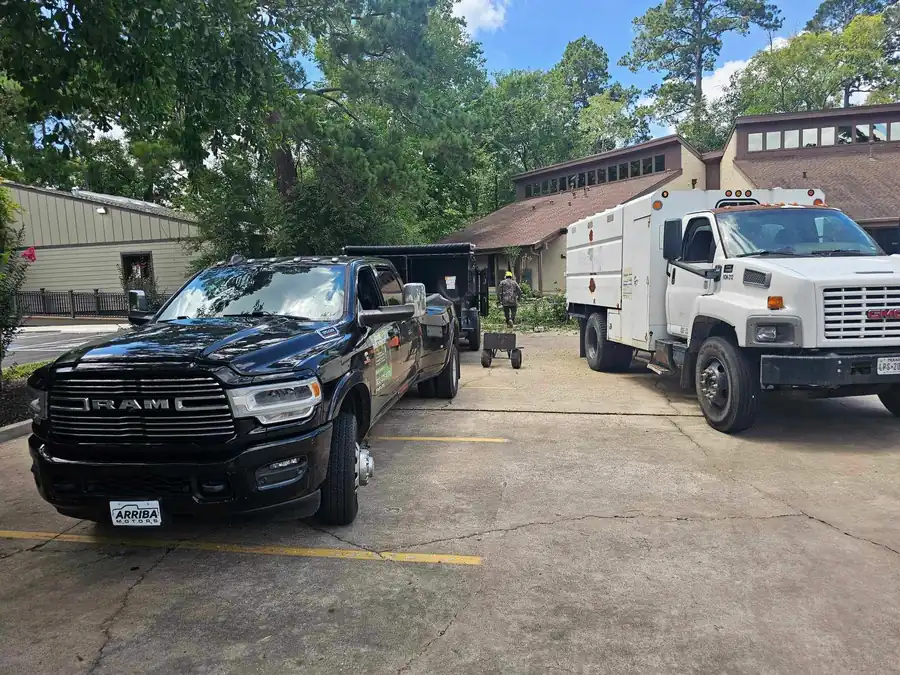 Commercial · Tree serviceCommercial tree service in Greater Houston for property managers and facility teams
 Service · Emergency tree removalEmergency tree removal and storm cleanup for Houston commercial properties and HOAs
Request a bid